
Absolute Decoupling in the European Union After the Paris Agreement
Thompson Rivers University
Climate change has created an urgent need for nations to balance economic development with
reducing greenhouse gas (GHG) emissions. The 2015 Paris Agreement marked a turning point by committing
signatories to limit global temperature increases to well below 2°C. The European Union (EU) reinforced this
commitment by setting a target of at least a 55% reduction in emissions by 2030 compared to 1990 levels,
equivalent to 2,307 MtCO2e (Climate Action Tracker, 2025). Beyond policy, the Paris Agreement also
serves as an indicator of progress toward decoupling growth from environmental degradation, where economies
expand while emissions fall—the essence of “green growth.”
| Period | MtCO2e (I) | Population (P) |
Affluence (GNI per capita, PPP) |
Technology (T) |
|---|---|---|---|---|
| 1996-2023 | -1.244 | 0.189 | 1.509 | -2.943 |
| 1996-2015 | -0.812 | 0.202 | 1.507 | -2.522 |
| 2016-2023 | -2.322 | 0.157 | 1.513 | -3.993 |
| 2024-2030 | -5.484 | 0.169 | 2.000 | -7.653 |
Note. IPAT (Impact = Population × Affluence × Technology). Indicator name/code: Population, total (SP.POP.TOTL); GNI per capita, PPP (constant 2021 international $) (NY.GNP.PCAP.PP.KD); Total greenhouse gas emissions excluding LULUCF (Mt CO2e) (EN.GHG.ALL.LU.MT.CE.AR5). Source: World Bank Open Data (European Union).
From Table 1, we observe that between 1996 and 2015, affluence in the EU grew by 1.51% annually, while MtCO2e emissions declined by -0.81% annually. Population growth remained stable at 0.20%, showing limited demographic influence. Carbon Intensity (Technology) fell by –2.52% per year, suggesting technological improvements were central to emissions reductions. These figures indicate absolute decoupling, where emissions dropped as the economy expanded. During the post-2015 Paris Agreement period (2016–2023), the results show stronger absolute decoupling. Affluence continued to increase by 1.51% annually, carbon intensity declined more steeply at –4%, and emissions fell more sharply at –2.32% per year. This shift points to reinforced decoupling, coinciding with the Paris Agreement, which provided incentives and targets that encouraged sustainable growth.
External factors must also be considered. The COVID-19 pandemic in 2020 caused a temporary emissions drop due to reduced transport and industrial activity. Excluding 2020–21, emissions fell at –2.63% annually, while GNI grew 2% and carbon intensity declined –4.63%. The pandemic temporarily accelerated emission reductions in 2020; emissions rebounded in 2021 as industrial activity and energy demand recovered. The difference between the full-period rate (–2.33%) and the adjusted rate (–2.63%) suggests that the overall decarbonization trend in the EU is largely structural. This indicates that long-term policy measures and technological improvements, rather than short-term disruptions, have driven post-Paris emission reductions.
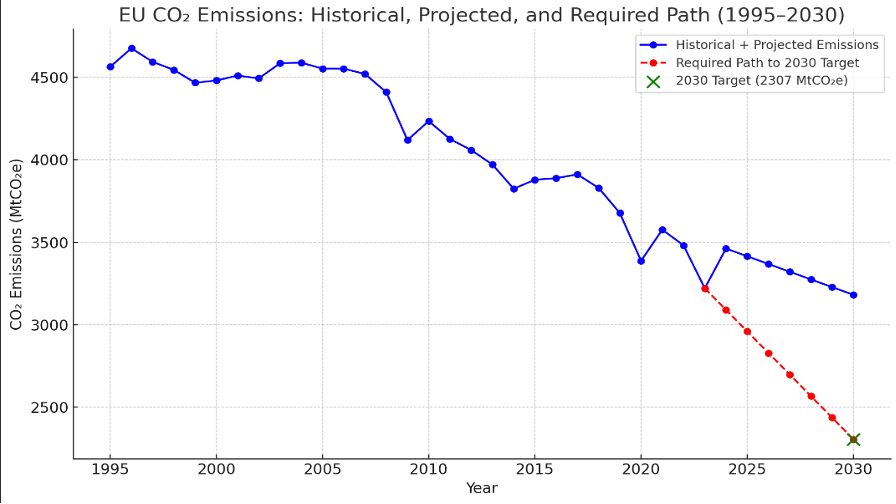
Figure 1. EU MtCO2e emissions from 1995 to 2030, including both historical and predicted values. The red dashed line represents the required decline from 2023 to 2030 to meet the 2030 target (2307 MtCO2e). The green point marks the 2030 target itself. (Image created by ChatGPT (GPT-5), 2025.)
Assuming 2% annual GDP growth, meeting the EU’s 2030 target would require a 7.65% yearly decline in carbon intensity and a 5.5% drop in emissions—far steeper than the -2.32% seen from 2016–2023—raising concerns about feasibility. As Ward et al. (2016) note, absolute decoupling is often temporary, as technological gains face limits. While the Paris Agreement has accelerated progress, sustaining a 5% annual reduction may be unrealistic without systemic change. A more realistic pathway would extend the 2030 target to around 2044-45, allowing emissions to fall more gradually while maintaining economic growth. This extended timeline would give the EU time to scale up renewable energy, improve efficiency, and implement deeper technological transitions essential for achieving net-zero.
The analysis demonstrates that the EU experienced notable absolute decoupling before 2015 and stronger decoupling afterward. This shift suggests that the Paris Agreement functioned as both a policy catalyst and an indicator of progress, signalling to governments and industries the importance of aligning economic and environmental priorities. Long-term EU strategies, such as the European Green Deal, have reinforced this momentum by embedding emission targets into economic planning (Cifuentes-Faura, 2022). Nagaj et al. (2024) show that improving energy efficiency, increasing renewable energy shares, and reducing fossil fuel dependence have had the most significant effects on lowering emissions across EU countries.
Technological innovation has been a central mechanism driving decoupling. Wu et al. (2023) found that economies achieving substantial reductions in GHG intensities, reflecting improved production efficiencies, were better able to advance decoupling, while those with stagnant or rising intensities struggled to align growth with sustainability. At the same time, the role of the circular economy cannot be overlooked. Huttmanová et al. (2024) showed that EU countries incorporating circular economy principles achieved substantial progress in resource efficiency, which reinforced decoupling. The variability across member states, however, shows that while the Paris Agreement set a unified framework, the success of decoupling depends heavily on national implementation and sectoral strategies. These findings emphasize that a comprehensive, adaptive policy mix, rather than a single approach, has been central to success.
The author contributed to the research concept, data analysis, writing, and editing of this paper and takes full responsibility for the accuracy, integrity, and originality of the content. AI tools were used to support readability, formatting, and language refinement. Specifically, ChatGPT was used to provide structural feedback and improve clarity of explanations. The author independently verified all information and performed the analysis. All errors, omissions, and interpretations remain the responsibility of the author and not the AI tools.
Figure 1. was created using ChatGPT in compliance with the OpenAI Terms of Use.
Cifuentes-Faura, J. (2022). European Union policies and their role in combating climate change over the years. Air Quality, Atmosphere and Health, 15(8), 1333–1340. https://doi.org/10.1007/s11869-022-01156-5
Europe’s environment. (2025, September 29). At a glance | European Environment Agency (EEA). https://www.eea.europa.eu/en/topics/at-a-glance/state-of-europes-environment
Huttmanová, E. ., Chovancová, J. ., Petruška, I. ., & Sallaku, K. . (2024). Circular economy in action: Examining the decoupling of economic growth and material use across EU countries. European Journal of Sustainable Development, 13(4), 13. https://doi.org/10.14207/ejsd.2024.v13n4p13
Nagaj, R., Gajdzik, B., Wolniak, R., & Grebski, W. W. (2024). The impact of deep decarbonization policy on the level of greenhouse gas emissions in the European Union. Energies (Basel), 17(5), 1245. https://doi.org/10.3390/en17051245
OpenAI. (2025). ChatGPT (GPT-5) [Large language model]. OpenAI. https://chat.openai.com
Targets. (21, Nov 2024.). EU: Country targets and climate action. Climate Action Tracker. https://climateactiontracker.org/countries/eu/targets/
Ward, J. D., Sutton, P. C., Werner, A. D., Costanza, R., Mohr, S. H., & Simmons, C. T. (2016). Is decoupling GDP growth from environmental impact possible? PloS One, 11(10), e0164733–e0164733. https://doi.org/10.1371/journal.pone.0164733
World Bank. (n.d.). European Union: World Bank data. Retrieved December 10, 2025 from https://data.worldbank.org/country/european-union
Wu, Z., Zhao, M., & Ye, Q. (2023). The influence of technology improvements and the consistency of environmental and economic indicators on decoupling of greenhouse gas emissions and economic growth. Sustainable Production and Consumption, 42, 14–22. https://doi.org/10.1016/j.spc.2023.09.003

This work is licensed under a Creative Commons
Attribution-NonCommercial-ShareAlike 4.0
International license