

Japan’s Decarbonization Pathway: Demographic Change and Emissions Intensity
Thompson Rivers University
In the 2015 Paris Climate Agreement, Parties agreed to keep the increase in global average temperature well below 2 °C above pre-industrial levels and to pursue efforts to limit the rise to 1.5 °C (United Nations Framework Convention on Climate Change [UNFCCC], 2015, Article 2). To reach these objectives, Parties further agreed to “reach global peaking of greenhouse gas emissions as soon as possible and to achieve a balance between anthropogenic emissions by sources and removals by sinks of greenhouse gases in the second half of this century.” This balance between greenhouse gas (GHG) emission sources and sinks is commonly referred to as achieving net zero GHG emissions. This commentary examines recent trends in Japan using the IPAT/Kaya framework, and tests whether the post-2015 period reflects a significant shift in Japan’s decarbonization trajectory.
Japan is the fourth-largest emitter of carbon dioxide (CO2) after the United States, China, and Russia. It is responsible for approximately 4.9% of global CO2 emissions, and its per capita emissions are about 9.8 tonnes of CO2. Despite progress in formulating climate policies against global warming in recent years, Japan’s commitment to achieving climate neutrality by 2050 remains weak (Sustainable Governance Indicators [SGI], 2023). In 2021, then-Prime Minister Suga Yoshihide announced a target to reduce GHG emissions by 46% by 2030 compared to 2013 levels and to reach carbon neutrality by 2050—a considerable increase from Japan’s previous target of a 26% reduction by 2030 (Japan Times, 2021; McKinsey, 2021).
Over the past five decades, Japan’s demographic and economic landscape has undergone dramatic shifts. The population grew steadily until peaking at around 128 million in 2010 but has since declined to roughly 124 million by 2024, reflecting the country’s well-documented aging and demographic challenges. Economically, Japan experienced rapid GDP per capita growth from the 1960s through the early 1990s, but growth plateaued through the 2000s and only recently has shown signs of renewed momentum. On the environmental front, GHG climbed alongside industrialization, peaked near 1,400 million tonnes of CO₂ equivalent in 2013, and declined significantly after 2015, reaching about 1,041 million tonnes in 2023, as the country pursues more sustainable and climate-conscious policies. These trends highlight Japan’s ongoing adaptation to demographic pressures, economic maturity, and the global imperative for decarbonization.
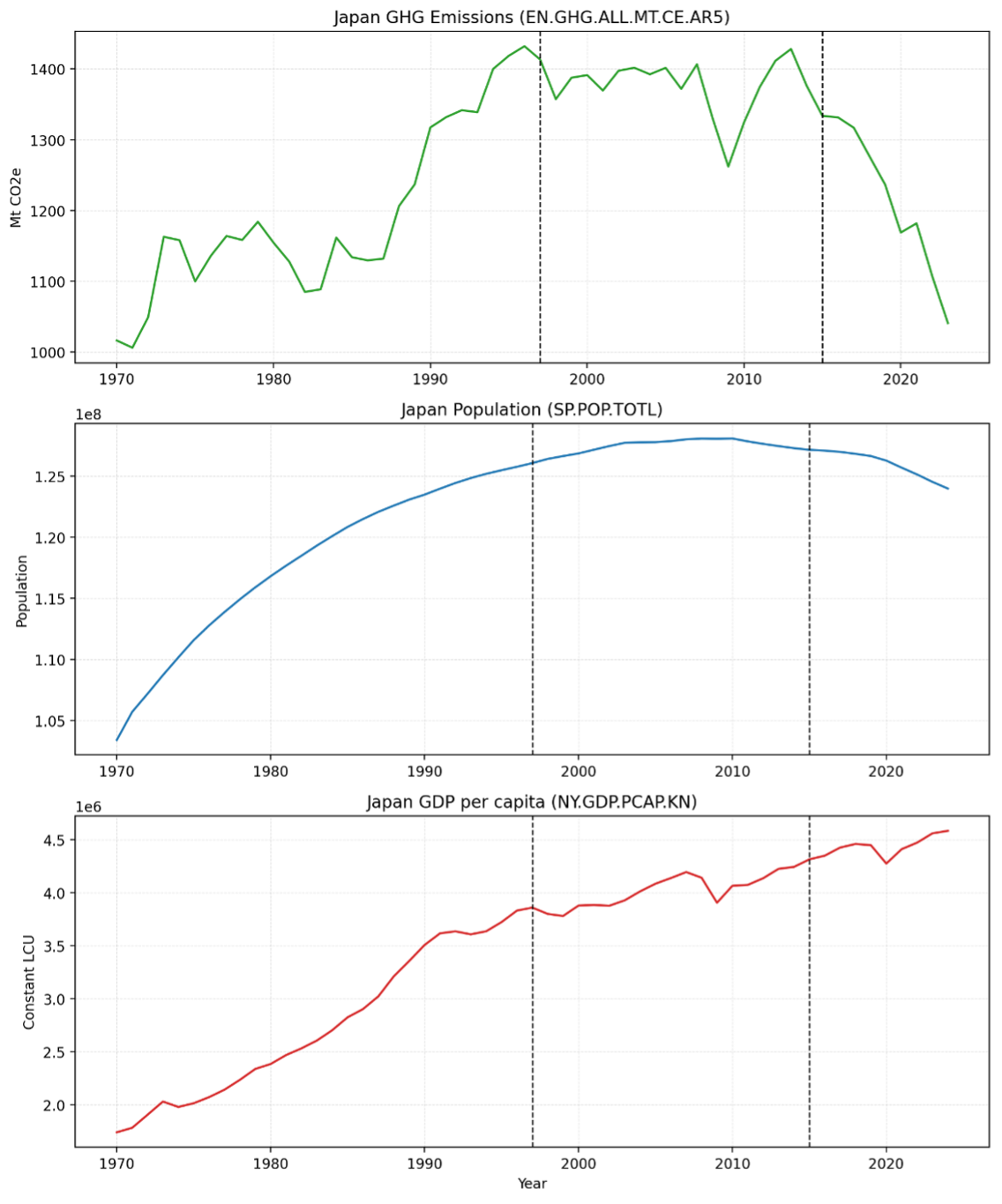
Figure 1: GHG Emissions, Population, and GDP per Capita (Figure created by Julius AI)
Figure 1 and Table 1 segment the analysis into three periods: (a) before the 1997 Kyoto Protocol, (b) between the Kyoto Protocol and the 2015 Paris Agreement, and (c) after 2015 until 2023. There is a clear progression in Japan’s development and emissions profile. From 1970 to 1997, the story is one of strong growth: GDP per capita rises rapidly, and emissions increase, but improvements in energy efficiency allowed emissions to grow more slowly than GDP. Before the Kyoto Protocol, Japan’s energy mix was dominated by fossil fuels, but nuclear energy expanded to form a large low-carbon share of electricity generation. The combination of nuclear expansion, efficiency gains, and structural economic change contributed to strong improvements in GHG intensity (GHG per GDP).
Between the Kyoto Protocol and Paris Agreement, 19972015, the economy continues to expand, though at a more moderate pace, while emissions flatten and begin to decline. Emissions intensity keeps improving, and population growth essentially stalls, marking a transitional phase. Nuclear power remained a large source of energy until the Fukushima disaster in 2011, forcing Japan to pivot back to fossil fuels, particularly liquified natural gas [LNG] and coal. Although efficiency and structural improvements still pushed emissions intensity down, the shock to the energy mix limited how far emissions could fall, so total GHG emissions declined only modestly over the period.
| Period | GHG emissions growth | Population growth | GDP per capita growth | GHG per GDP growth |
|---|---|---|---|---|
| 1970-1997 | 1.23 | 0.74 | 2.99 | -1.71 |
| 1997-2015 | -0.32 | 0.05 | 0.62 | -0.94 |
| 2015-2023 | -3.05 | -0.26 | 0.7 | -3.72 |
In the most recent decade, from 2013 to 2023, just prior to the Paris Agreement, Japan’s GHG emissions started declining (Oshiro et al., 2019; Sugiyama et al., 2019; Sugiyama et al., 2021). While technological advances and population decline contributed to reductions, heavy industry and transportation remain challenging sectors to decarbonize (Sugiyama et al., 2019; Kii, 2020; Yamada et al., 2023). In addition, GDP per capita grew modestly due to COVID-19 in 2020, but emissions fell sharply, and emissions intensity per unit of GDP dropped even faster, while population declined. Japan now appears to be entering a phase in which its economic performance is increasingly dominated by climate policy and deeper structural changes.
Japan’s greenhouse gas emissions have seen a marked and steady decline since 2015, driven mainly by improved energy efficiency, an expanding share of renewables, and reductions in energy consumption across major sectors (Ministry of the Environment, Japan, 2016; Carbon Brief, 2021). The results of this commentary support the hypothesis that Japan’s GHG emissions and carbon intensity declined more rapidly after the Paris Agreement, with multi-year reductions aligned with more ambitious national climate targets. Despite this progress, Japan will need to accelerate decarbonization significantly to achieve its 2030 target—a 46% reduction from 2013 levels—and its 2050 net-zero commitment (Herran & Fujimori, 2021).
I, Adedolapo declare that I’ve used Julius AI and Perplexity AI as tools; they provided insights into the topic and supported readability and language. Note: The graph in Figure 1 was created by Julius AI after providing the data. All errors, biases, and omissions remain the author’s, not the AI tools.
Encyclopaedia Britannica. (n.d.). Negotiations and agreement. In Paris Agreement. https://www.britannica.com/topic/Paris-Agreement-2015/Negotiations-and-agreement
Kii, M. (2020). Reductions in CO2 emissions from passenger cars under demography and technology scenarios in Japan by 2050. Sustainability. https://doi.org/10.3390/su12176919
Ministry of the Environment, Japan. (2016, December 5). Japan’s national greenhouse gas emissions in fiscal year 2015. https://www.env.go.jp/en/headline/2287.html
Oshiro, K., Gi, K., Fujimori, S., Van Soest, H., Bertram, C., Després, J., Masui, T., Rochedo, P., Roelfsema, M., & Vrontisi, Z. (2019). Mid-century emission pathways in Japan associated with the global 2 °C goal: National and global models assessments based on carbon budgets. Climatic Change, 162, 19131927. https://doi.org/10.1007/s10584-019-02490-x
Silva Herran, D., & Fujimori, S. (2021). Beyond Japanese NDC: Energy and macroeconomic transitions towards 2050 in emission pathways with multiple ambition levels. Sustainability Science, 16, 489501. https://doi.org/10.1007/s11625-021-00930-1
Sugiyama, M., Fujimori, S., Fujimori, S., Wada, K., Endo, S., Fujii, Y., Komiyama, R., Kato, E., Kurosawa, A., Matsuo, Y., Oshiro, K., Sano, F., & Shiraki, H. (2019). Japan's long-term climate mitigation policy: Multi-model assessment and sectoral challenges. Energy. https://doi.org/10.1016/j.energy.2018.10.091
Sugiyama, M., Fujimori, S., Wada, K., Oshiro, K., Kato, E., Komiyama, R., Herran, D., Matsuo, Y., Shiraki, H., & Ju, Y. (2021). EMF 35 JMIP study for Japan’s long-term climate and energy policy: Scenario designs and key findings. Sustainability Science, 16, 355374. https://doi.org/10.1007/s11625-021-00913-2
Sustainable Governance Indicators [SGI]. (2023, September 16). Japan: Environmental sustainability. https://www.sgi-network.org/2024/Japan/Environmental_Sustainability
United Nations Framework Convention on Climate Change. (2015). Paris Agreement [PDF]. https://unfccc.int/sites/default/files/english_paris_agreement.pdf
World Bank. (n.d.). Japan. In DataBank: World Development Indicators. https://data.worldbank.org/country/japan
Yamada, K., , R., Yamamoto, M., Ueda, H., & Sakai, S. (2023). Japan’s greenhouse gas reduction scenarios toward net zero by 2050 in the material cycles and waste management sector. Journal of Material Cycles and Waste Management, 25, 18071823. https://doi.org/10.1007/s10163-023-01650-7

This work is licensed under a Creative Commons
Attribution-NonCommercial-ShareAlike 4.0
International license