
Economic Slowdown or Decarbonization? Understanding Brazil’s Emission Pathways Through IPAT Decomposition
Thompson Rivers University
This commentary discusses Brazil’s GHG trends focusing on the pre- and post-2015 Paris Agreement periods. The evidence in this perspective piece indicates that since 2015, Brazil’s slowdown in carbon dioxide (CO₂) emissions growth has been driven mainly by weaker gross domestic product (GDP) per-capita growth rather than an acceleration in carbon-intensity gains.
The Kaya identity decomposes CO₂ into four multiplicative drivers: Population (P) × GDP per capita (A) × Energy intensity of GDP (E/GDP) × Carbon intensity of energy (CO₂/E). The last two are summarized as carbon intensity (T), or emissions per unit of activity. Changes in total emissions thus come from demographic expansion, income growth, and technology or structural shifts that may reduce the carbon required to produce a unit of output.
| Period | CO₂ (%) | Population (%) | GDP per capita (%) | Carbon Intensity (%) |
|---|---|---|---|---|
| 1997-2014 | 1.10 | 1.89 | 2.42 | -0.57 |
| 2015-2023 | 0.60 | -0.06 | 0.28 | -0.26 |
| 1997-2023 | 0.93 | 1.24 | 1.71 | -0.47 |
Note. Data were retrieved from the World Bank (September 2025). CO2 annual growth rates were calculated using total greenhouse gas emissions excluding LULUCF (Mt CO2e), 19702023 (EN.GHG.ALL.LU.MT.CE.AR5). Population annual growth rates were calculated using total population (SP.POP.TOTL). GDP per capita annual growth rates were calculated using GDP per capita (constant LCU) (NY.GDP.PCAP.KN).
From 1997–2014, prior to the Paris Agreement and following the 1997 Kyoto Protocol, Brazil’s CO₂ emissions grew by 1.10% annually, with population increasing 1.89% per year and GDP per capita rising 2.42% per year, while carbon intensity fell by 0.57% per year (see Table 1). After 2015, CO₂ growth slowed sharply to 0.60% per year. The carbon-intensity decline maintained a similar pace (0.26% per year), but GDP per capita growth collapsed to 0.28% annually, and population growth declined to 0.06% per year. Over the full 1997–2023 period, CO₂ rose 0.93% annually with a 0.47% per-year fall in carbon intensity.
Two takeaways follow. First, carbon intensity has shown gradual improvement since the early 2000s, supported by Brazil’s alternative electricity sources dominated by hydropower and complemented by the rapid growth of wind, solar, and bioenergy sources (Milhorance et al., 2021). Second, the post-2015 break in total emissions is explained more by demand-side weakness (slower income growth) than by accelerated decarbonization of supply, since the rate of carbon-intensity improvement did not speed up after 2015 (Firpo, 2024).
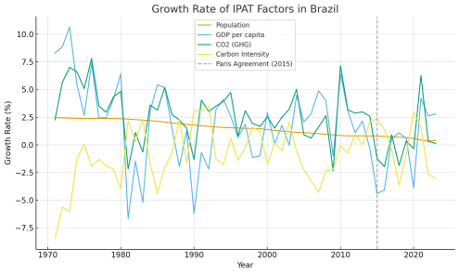
Figure 1. Trends in IPAT forces for Brazil (Average Annual Growth Rates). (Figure generated by ChatGPT.)
Brazil’s emissions profile is unusual among large economies: land-use change (deforestation) and agriculture (methane and nitrous oxide) are major contributors alongside energy (de Azevedo et al., 2018). Recent analyses by the Brazilian government highlight that the GHG intensity of electricity generation has remained among the lowest globally as wind and solar additions accelerate (Government of Brazil, 2024). In 2024, Brazil adopted a national cap-and-trade framework (ICAP, 2024), establishing legal foundations for compliance-based carbon markets. However, previous experiences suggest that enforcement capacity and inter-agency coordination will determine the system’s effectiveness (Pereira & Viola, 2021; Hochstetler, 2021). In its updated Nationally Determined Contribution (NDC), Brazil reaffirmed its net-zero target by 2050 and pledged deeper emission cuts by the 2030s (Climate Action Tracker, 20242025).
Moreover, emissions from Amazon wildfires increasingly undermine the gains from reduced deforestation and sustainable land-use practices. During drought years, wildfire-related CO₂ emissions can approach half of those from deforestation, releasing large amounts of greenhouse gases and weakening Brazil’s overall mitigation progress (Aragão et al., 2018; Gatti et al., 2021). These fires, along with ongoing degradation and deforestation, have diminished the rainforest’s ability to act as a carbon sink, with about 38% of the forest now degraded and some eastern regions becoming net carbon sources (Lapola et al., 2023). As the “lungs of the world,” the Amazon’s declining resilience and growing risk of crossing an ecological tipping point threaten both regional and global climate stability, highlighting the urgency of stronger forest governance and fire management (Boulton et al., 2021; Lovejoy & Nobre, 2019).
Achieving lasting decoupling will require deeper action in land-use change and agriculture, which are Brazil’s largest emission sources. Strengthened deforestation control, sustainable agriculture, and renewable-energy expansion could jointly advance the structural decarbonization needed for long-term targets (Carauta et al., 2021; Milhorance et al., 2022). However, current evidence suggests that Brazil’s overall performance toward its emission targets remains insufficient. The persistence of deforestation, uneven policy enforcement, and economic pressures continue to limit progress. As a result, Brazil may need to reassess the ambition and feasibility of its targets to ensure alignment with global 1.5°C pathways and to complement its land-use and agricultural reforms with robust forest governance, fire management, and climate enforcement mechanisms.
While the data support the hypothesis that post-2015 emissions moderation reflects weak GDP growth, limitations such as sectoral aggregation, COVID shocks, and short time horizons mean the findings should be interpreted cautiously. Stronger conclusions will require disaggregated sectoral data and longer time series as Brazil’s climate policies mature.
The author contributed to the concept, writing, and editing, and takes full responsibility for the paper’s content, accuracy, and integrity. The author acknowledges the use of ChatGPT as a tool that provided insights into the topic and supported readability and language. Consensus was used for the literature review. The table and figure were created by ChatGPT after providing the data. All errors, biases, and omissions remain the author’s, and not those of the AI tools.
Aragão, L. E. O. C., Anderson, L. O., Fonseca, M. G., Rosan, T. M., Vedovato, L. B., Wagner, F. H., Silva, C. V. J., Arai, E., Aguiar, A. P. D., Barlow, J., Berenguer, E., Deeter, M. N., Domingues, L. G., Gatti, L. V., Gloor, M., Malhi, Y., Marengo, J. A., Miller, J. B., Phillips, O. L., & Saatchi, S. S. (2018). 21st century drought-related fires counteract the decline of Amazon deforestation carbon emissions. Nature Communications, 9(1), 536. https://doi.org/10.1038/s41467-017-02771-y
Boulton, C., Lenton, T., & Boers, N. (2021). Pronounced loss of Amazon rainforest resilience since the early 2000s. Nature Climate Change, 12, 271–278. https://doi.org/10.1038/s41558-022-01287-8
Carauta, M., Troost, C., Guzman-Bustamante, I., Hampf, A., Libera, A., Meurer, K., Bönecke, E., Franko, U.,Rodrigues, R., & Berger, T. (2021). Climate-related land-use policies in Brazil: How much has been achieved with economic incentives in agriculture? Land Use Policy, 109, 105618. https://doi.org/10.1016/j.landusepol.2021.105618
Climate Action Tracker. (20242025). Brazil—Country assessment and targets. https://climateactiontracker.org/countries/brazil/
de Azevedo, T., Costa Junior, C., Brandão Junior, A. et al. (2018). SEEG initiative estimates of Brazilian greenhouse gas emissions from 1970 to 2015. Scientific data, 5, 180045. https://doi.org/10.1038/sdata.2018.45
Firpo, S., Portella, A. L. (2024). The labor market in Brazil, 2001–2022. IZA World of Labor, 2024, 441. https://doi.org/10.15185/izawol.441.v2
Gatti, L. V., Basso, L. S., Miller, J. B., Gloor, M., Domingues, L. G., Cassol, H. L. G., Tejada, G., Aragão, L. E. O. C., Nobre, C., Peters, W., Marani, L., Arai, E., Sanches, A. H., Corrêa, S. M., Anderson, L. O., Von Randow, C., Correia, C. S. C., Crispim, S. P., & Neves, R. A. L. (2021). Amazonia as a carbon source linked to deforestation and climate change. Nature, 595(7867), 388–393. https://doi.org/10.1038/s41586-021-03629-6
Government of Brazil. (2024, Oct.). Brazil to rank among countries with lowest GHG emissions in energy production, study finds. https://www.gov.br/secom/en/latest-news/2024/10/brazil-to-rank-among-countries-with-lowest-greenhouse-gas-emissions-in-energy-production-study-finds
Hochstetler, K. (2021). Climate institutions in Brazil: Three decades of building and dismantling climate capacity. Environmental Politics, 30(sup1), 49–70. https://doi.org/10.1080/09644016.2021.1957614
International Carbon Action Partnership (ICAP). (2024, Nov.). Brazil adopts cap-and-trade system (SBCE). https://icapcarbonaction.com/en/news/brazil-adopts-cap-and-trade-system
Lapola, D. M., Pinho, P., Barlow, J., Aragão, L. E. O. C., Berenguer, E., Carmenta, R., Liddy, H. M., Seixas, H., Silva, C. V. J., Silva‐Junior, C. H. L., Alencar, A., Anderson, L. O., Armenteras, D., Brovkin, V., Calders, K., Chambers, J. Q., Chini, L. P., Costa, M. H., Faria, B. L., ... Walker, W. S. (2023). The drivers and impacts of Amazon forest degradation. Science, 379(6632), 280–285. https://doi.org/10.1126/science.abp8622
Lovejoy, T. E., & Nobre, C. (2019). Amazon tipping point: Last chance for action. Science Advances, 5(12), eaba2949. https://doi.org/10.1126/sciadv.aba2949
Milhorance, C., Sabourin, E., Chechi, L., & Mendes, P. (2021). The politics of climate change adaptation in Brazil: Framings and policy outcomes for the rural sector. Environmental Politics, 31, 183–204. https://doi.org/10.1080/09644016.2021.1907097
Milhorance, C., Howland, F., Sabourin, E., & Le Coq, J. F. (2022). Tackling the implementation gap of climate adaptation strategies: Understanding policy translation in Brazil and Colombia. Climate Policy, 22I(9-10), 1113–1129. https://doi.org/10.1080/14693062.2022.2085650
Pereira, J. C., & Viola, E. (2022). Brazilian climate policy (1992–2019): An exercise in strategic diplomatic failure. Contemporary Politics, 28(1), 55–78. https://doi.org/10.1080/13569775.2021.1961394
World Bank. (n.d.). Brazil. In Databank: World Development Indicators. Retrieved September 30, 2025, from https://data.worldbank.org/country/BR

This work is licensed under a Creative Commons
Attribution-NonCommercial-ShareAlike 4.0
International license