
Singapore’s Economic Expansion and Relative Decoupling of CO₂ Emissions
Thompson Rivers University
This commentary applies the IPAT framework to Singapore, a city-nation with one of the highest standards of living in the world (List of countries by GDP (PPP) per capita, 2025). Given such prosperity, Singapore should be leading in emission reduction—but is it? To answer this query, this short opinion piece decomposes the three main factors—population growth, affluence, and technology—that influence CO₂ emissions in Singapore’s economy.
Singapore has experienced sustained GDP growth, becoming one of the world’s most prosperous economies. However, this expansion scales up overall economic activity, thereby leading to higher CO₂ emissions (Ali et al., 2016). A higher standard of living, usually measured by GDP per capita, can also encourage stricter regulations, which redirect firms and consumers toward cleaner and more efficient technologies (Su & Ang, 2020). Such technological advancements tend to reduce the carbon intensity of GDP and can offset emissions arising from growth. Yet, as shown in Figure 1, the scale effect of economic growth has been stronger than technological improvements, driving emissions upward. Singapore’s rising population and affluence have not been sufficiently counterbalanced by improvements in energy and carbon intensity (Chen & Taylor, 2020).
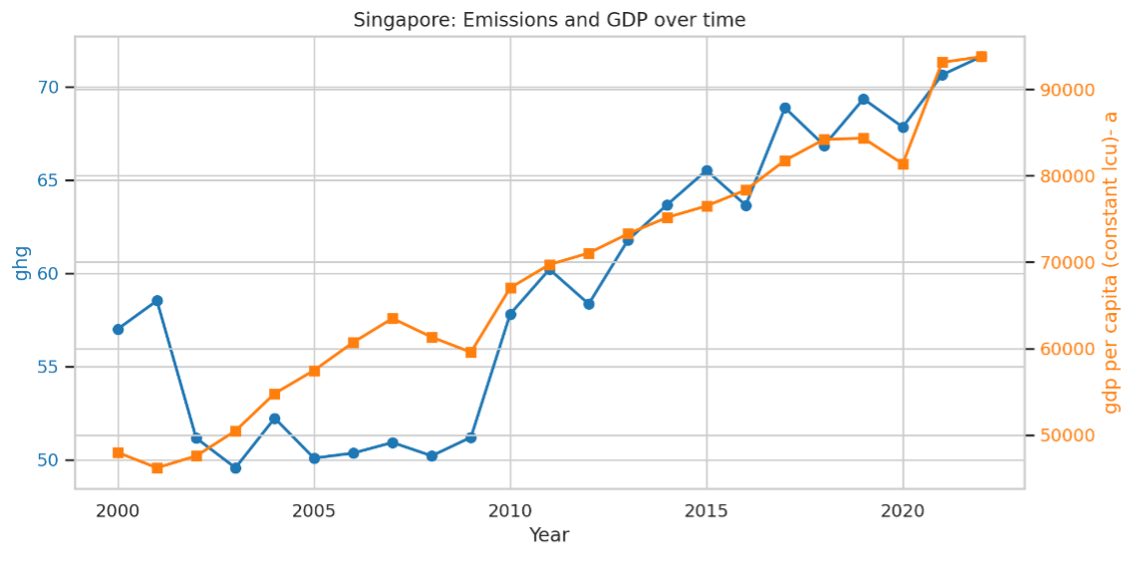
Figure 1: GDP Rises with CO2 Emissions Over Time (Julius AI, 2025).
Table 1 shows the average growth rates of population, GDP per capita, GDP, and carbon intensity across time periods and aligns these trends with their corresponding impacts on CO2 emissions.
| Period | Population Growth Rate | GDP per Capita Growth Rate | GDP Growth Rate | Carbon Intensity | CO2 Emissions Growth |
|---|---|---|---|---|---|
| 2001-2022 | 1.53 | 3.05 | 4.58 | -3.54 | 1.04 |
| 2001-2015 | 2.12 | 3.11 | 5.23 | -4.30 | 0.93 |
| 2016-2022a | 0.26 | 2.91 | 3.17 | -1.9 | 1.27 |
| 2016-2022b | 0.36 | 3.99 | 4.35 | -2.5 | 1.85 |
| 2023-2030 | 0.50 | 3.50 | 4.0 | -6.74 | -2.74 |
Note. Period 2016-2022a includes the 2020 COVID-19 year, whereas 2016-2022b excludes the 2020 COVID-19 year (World Bank Open Data, Singapore).
The data suggest that in Singapore, economic growth continues to outpace reductions in carbon intensity, leading to rising CO₂ emissions. Prior to the Paris Agreement, between 2001 and 2015, GDP grew by more than 5% annually, outstripping improvements in carbon intensity. The evidence indicates that sustainability mechanisms have not yet been sufficiently strong to offset the pressures of the rapid economy. While investments in clean technology and structural reforms are underway, the data show that Singapore has so far achieved only relative decoupling—emissions have risen more slowly than GDP but have not declined in absolute terms.
The projection to 2030 highlights the scale of Singapore’s decarbonization challenge: emissions must decline from 74.3 MtCO₂e in 2023 to 60 MtCO₂e by 2030, representing an annual reduction of approximately 2.7% and requiring a 6.7% yearly decrease in carbon intensity—almost double the historical rate of improvement (Raihan & Tuspekova, 2022). Achieving this trajectory is highly ambitious and will require accelerated energy transitions, substantial efficiency gains, and expanded regional cooperation on low-carbon energy imports. Without such transformative measures, Singapore risks remaining in a state of relative decoupling, falling short of its climate commitments and its potential to serve as a global leader in sustainable urban development (Katircioğlu, 2014).
A strong policy pathway for Singapore would be to accelerate its transition to renewable and low-carbon energy sources by expanding solar capacity, scaling up regional green electricity imports, and tightening carbon pricing under its existing carbon tax (Lau et al., 2021). Complementary measures, such as incentives for energy-efficient technologies in transport, industry, and buildings, alongside investments in carbon capture and waste-to-energy systems, would further reduce carbon intensity while sustaining economic growth (Alva et al., 2024). Singapore has already introduced several such initiatives, including Southeast Asia’s first carbon tax (scheduled to rise to S$50–80 per tonne by 2030), a shift in power generation from oil to natural gas, and plans for large-scale solar deployment and electricity imports (Loh & Bellam, 2024). Yet, despite these efforts, land constraints and reliance on imported energy mean that only relative decoupling has been achieved to date. To reach net-zero emissions by 2050, Singapore must accelerate its clean-energy transition at an unprecedented pace.
This commentary is a result of my independent analysis; however, I acknowledge the use of ChatGPT (version 5) and Julius AI artificial intelligence tools solely for the purpose of refining language and also coming up with the necessary graph to represent the analyzed data. All interpretations, arguments, and conclusions presented are entirely my own.
Alva, P., Mosteiro-Romero, M., Miller, C., & Stouffs, R. (2024). Mitigating operational greenhouse gas emissions in ageing residential buildings using an urban digital twin dashboard. Energy and Buildings, 302, Article 114681. https://doi.org/10.1016/j.enbuild.2024.114681
Ali, H., Abdul-Rahim, A., & Ribadu, M. (2016). Urbanization and carbon dioxide emissions in Singapore: Evidence from the ARDL approach. Environmental Science and Pollution Research, 24(2), 1967–1974. https://doi.org/10.1007/s11356-016-7935-z
Chen, Q., & Taylor, D. (2020). Economic development and pollution emissions in Singapore: Evidence in support of the environmental Kuznets curve hypothesis and its implications for regional sustainability. Journal of Cleaner Production, 243, Article 118637. https://doi.org/10.1016/j.jclepro.2019.11863
Julius AI. (2025). Julius AI [Large language model]. https://julius.ai/
Katircioğlu, S. (2014). Testing the tourism-induced EKC hypothesis: The case of Singapore. Economic Modelling, 41, 383–391. https://doi.org/10.1016/j.econmod.2014.05.028
Lau, H., Ramakrishna, S., Zhang, K., & Hameed, M. (2021). A decarbonization roadmap for Singapore and its energy policy implications. Energies, 14(20), Article 6455. https://doi.org/10.3390/en14206455
List of countries by GDP (PPP) per capita. (2025). In Wikipedia. Retrieved October 6, 2025, from https://en.wikipedia.org/wiki/List_of_countries_by_GDP_(PPP)_per_capita
Loh, J., & Bellam, S. (2024). Towards net zero: Evaluating energy security in Singapore using system dynamics modelling. Applied Energy, 353, Article 122537. https://doi.org/10.1016/j.apenergy.2023.122537
OpenAI. (2025). ChatGPT (Oct 6 version) [Large language model]. https://chat.openai.com/
Raihan, A., & Tuspekova, A. (2022). The nexus between economic growth, energy use, urbanization, tourism, and carbon dioxide emissions: New insights from Singapore. Sustainability Analytics and Modeling, 2, Article 100009. https://doi.org/10.1016/j.samod.2022.100009
Su, B., & Ang, B. (2020). Demand contributors and driving factors of Singapore’s aggregate carbon intensities. Energy Policy, 146, 111817. https://doi.org/10.1016/j.enpol.2020.111817
World Bank Group. (2025). Singapore | Data. World Bank Open Data. https://www.worldbank.org/en/country/singapore

This work is licensed under a Creative Commons
Attribution-NonCommercial-ShareAlike 4.0
International license