
Saudi Arabia’s Greenhouse Gas
Trajectory Policy Transitions and
Kaya Decomposition
Analysis
Thompson Rivers University
Saudi Arabia’s greenhouse gas (GHG) emissions reveal the dual pressures of economic growth and energy dependence. Between 1997 and 2023, the country’s emissions trajectory illustrates both rapid expansion and early policy reform. This commentary applies the Kaya identity (E = P × A × T). Within the Kaya identity, affluence (A) represents GDP per capita, population (P) represents total population, and technology (T) represents carbon intensity (emissions per unit of GDP). The year 2015 marks a turning point associated with the Paris Agreement and the launch of Vision 2030, a framework that integrates sustainability, diversification, and energy efficiency into national policy (Kingdom of Saudi Arabia, 2016; World Bank, 2025).
Data were sourced from the World Bank’s World Development Indicators (2025). Total GHG emissions excluding LULUCF, (EN.GHG.ALL.MT.CE.AR5), population (SP.POP.TOTL), and GDP per capita (NY.GDP.PCAP.KN) were used to construct GDP (population × GDP per capita) and derive carbon intensity (defined as emissions per unit of GDP). Average Annual Growth Rates (AAGR) were calculated for pre-Paris (1997 to 2014) and post-Paris (2015 to 2023) Agreement periods to examine the effects of policy changes. Cross-checking with Our World in Data (2025) confirmed consistent emission patterns.
In this analysis, GDP refers to total national economic output, reconstructed as the product of population and GDP per capita (in constant local currency units). The GDP column in Table 1 reflects aggregate output growth. This clarification ensures conceptual consistency when distinguishing between population, affluence, and technological intensity effects on emissions.
| Period | Emissions (E) (%) | Population (P)(%) | GDP(%) | Intensity (T)(%) | Per capita (E)(%) |
|---|---|---|---|---|---|
| 1997 to 2014 | 5.0% | 4.1% | 4.3% | +0.7% | +0.9% |
| 1997 to 2015 | 0.8% | 1.5% | 2.8% | −1.9% | −0.7% |
| 2015 to 2023 | 5.0% | 4.1% | 4.3% | +0.7% | +0.9% |
Note. Total GHG emissions (excluding LULUCF) were sourced from the World Bank (2025). Population and GDP per capita data were used to construct GDP (population × GDP per capita) and derive carbon intensity (emissions relative to GDP).
From 1997 to 2014, GHG emissions grew at approximately 5 percent per year, outpacing population growth (4.1 percent) and GDP (4.3 percent). These years were characterized by fuel subsidies, industrial expansion, and limited efficiency standards. Rapid population growth also reflected the inflow of foreign workers during periods of oil-sector expansion (World Bank, 2025). Post 2015, emissions growth slowed to 0.8 percent annually, while GDP continued to grow by 2.8 percent. Carbon intensity declined by nearly 1.9 percent per year, indicating relative decoupling. This shift corresponds with Vision 2030, which encouraged renewable projects such as the Sakaka and Sudair solar plants and the NEOM hydrogen initiative (IEA, 2025; Shehri et al., 2022).
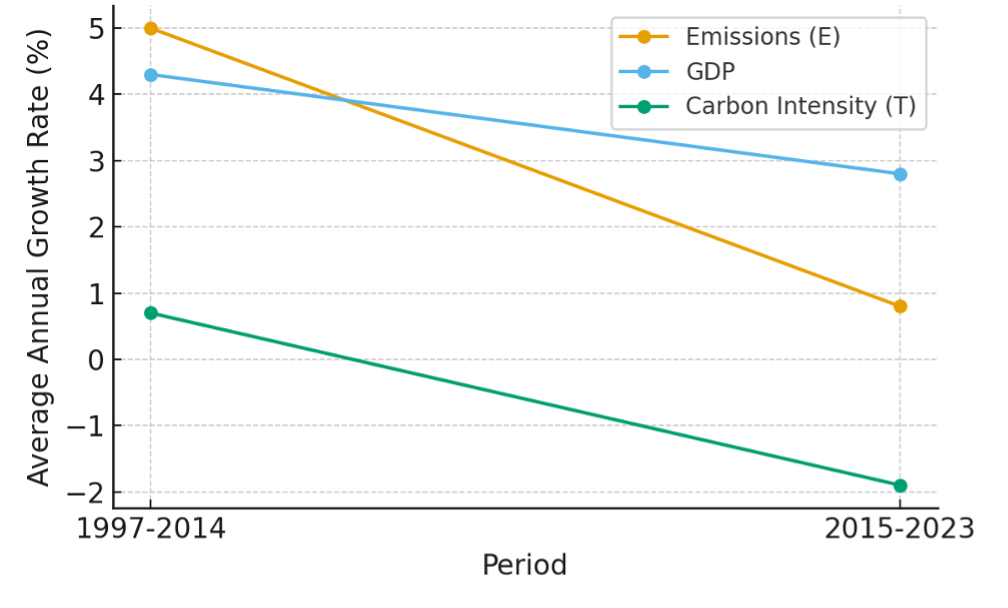
Figure 1: Indexed Trends in GDP, Emissions, and Carbon Intensity (1997 to 2023). Source: (World Bank, 2025; Our World in Data, 2025). Indexed values were calculated from World Bank data and verified against Our World in Data records.
Note. Figure generated with assistance from OpenAI ChatGPT (October 2025 version) using World Bank and Our World in Data datasets
Saudi Arabia’s policy evolution supports these quantitative trends. The Circular Carbon Economy (CCE) framework—reduce, reuse, recycle, remove—has been central to the country’s decarbonization strategy (Shehri et al., 2022). Vision 2030 and the Saudi Green Initiative promote renewable energy sources (“renewables”), carbon capture and storage [CCS], {and green hydrogen. However, implementation remains incomplete, and the Climate Action Tracker (2025) still classifies the country’s targets as insufficient relative to the Paris Agreement. Studies emphasize barriers in industrial emissions, workforce readiness, and water-energy integration (Islam and Ali, 2024; Solangi et al., 2025). Overall, the data and literature converge: Saudi Arabia is achieving relative decoupling, but achieving sustained absolute emission reductions will require accelerated structural change.
Saudi Arabia’s GHG trajectory from 1997 to 2023 demonstrates two distinct phases. The pre-2015 period reflected emissions driven by economic and population growth, while the post-2015 period shows emerging decoupling as policy and technology improve. Achieving net zero emissions by 2060 will depend on sustained investment in renewables, energy efficiency, and robust, transparent monitoring systems. The Kingdom’s challenge is to transform policy frameworks into measurable, economy-wide emission reductions (Kamboj et al., 2024; Climate Action Tracker, 2025).
The author conceptualized the commentary, gathered and analyzed all data, and developed the final interpretation. OpenAI ChatGPT (October 2025 version) was used to enhance clarity, structure, APA reference formatting, and to generate Figure 1 based on public data sources. The Consensus AI research platform was also used to identify and synthesize peer reviewed literature for the policy and climate framework sections. All conclusions and interpretations remain solely the responsibility of the author.
Climate Action Tracker. (2025). Saudi Arabia: Country summary. https://climateactiontracker.org/countries/saudi-arabia/
International Energy Agency [IEA]. (2025). Energy system of Saudi Arabia. https://www.iea.org/countries/saudi-arabia
Islam, M. T., and Ali, A. (2024). Sustainable green energy transition in Saudi Arabia: Characterizing policy framework, interrelations and future research directions. Next Energy, 5, 100161. https://doi.org/10.1016/j.nxener.2024.100161
Kamboj, P., Hejazi, M., Qiu, Y., Kyle, P., and Iyer, G. (2024). The path to 2060: Saudi Arabia’s long term pathway for GHG emission reduction. Energy Strategy Reviews, 55, 101537. https://doi.org/10.1016/j.esr.2024.101537
Kingdom of Saudi Arabia. (2016). Saudi Vision
0). Saudi Arabia: CO2 Country Profile (CO2 and greenhouse gas emissions [in Saudi Arabia]). https://ourworldindata.org/co2/country/saudi-arabia
Shehri, T., Braun, J., Howarth, N., Lanza, A., and Luomi, M. (2022). Saudi Arabia’s climate change policy and the circular carbon economy approach. Climate Policy, 23(1), 151–167. https://doi.org/10.1080/14693062.2022.2070118
Solangi, Y., Alyamani, R., and Almakhles, D. (2025). Evaluating challenges and policy innovations for renewable energy development in a circular economy: A path to environmental resilience in Saudi Arabia. Journal of Environmental Management, 375, 124124. https://doi.org/10.1016/j.jenvman.2025.124124
World Bank. (n.d.). World Development Indicators: Countries and Economies [EN.GHG.ALL.MT.CE.AR5; SP.POP.TOTL; NY.GDP.PCAP.KN]. In World Bank Open Data. https://data.worldbank.org/

This work is licensed under a Creative Commons
Attribution-NonCommercial-ShareAlike 4.0
International license