
Russia’s Greenhouse Gas Emissions: Decline Driven by Economic Contraction
Thompson Rivers University
The Russian Federation has experienced several volatile periods, both domestically and on the global stage, often caused by its turbulent political climate, the impacts of war, and by larger global forces (Bradley & Eberle, 2024; Gaddy & Ickes, 2010; Sanghi et al., 2021). In this commentary, we examine three prominent moments—the collapse of the Soviet Union, the global financial crisis, and the Covid-19 pandemic—and their impacts on emissions using the IPAT framework (Brizga et al., 2013) for the Russian Federation from 1990 to 2023. Population data were omitted from the analysis as they were not found to be major drivers of changes in emissions.
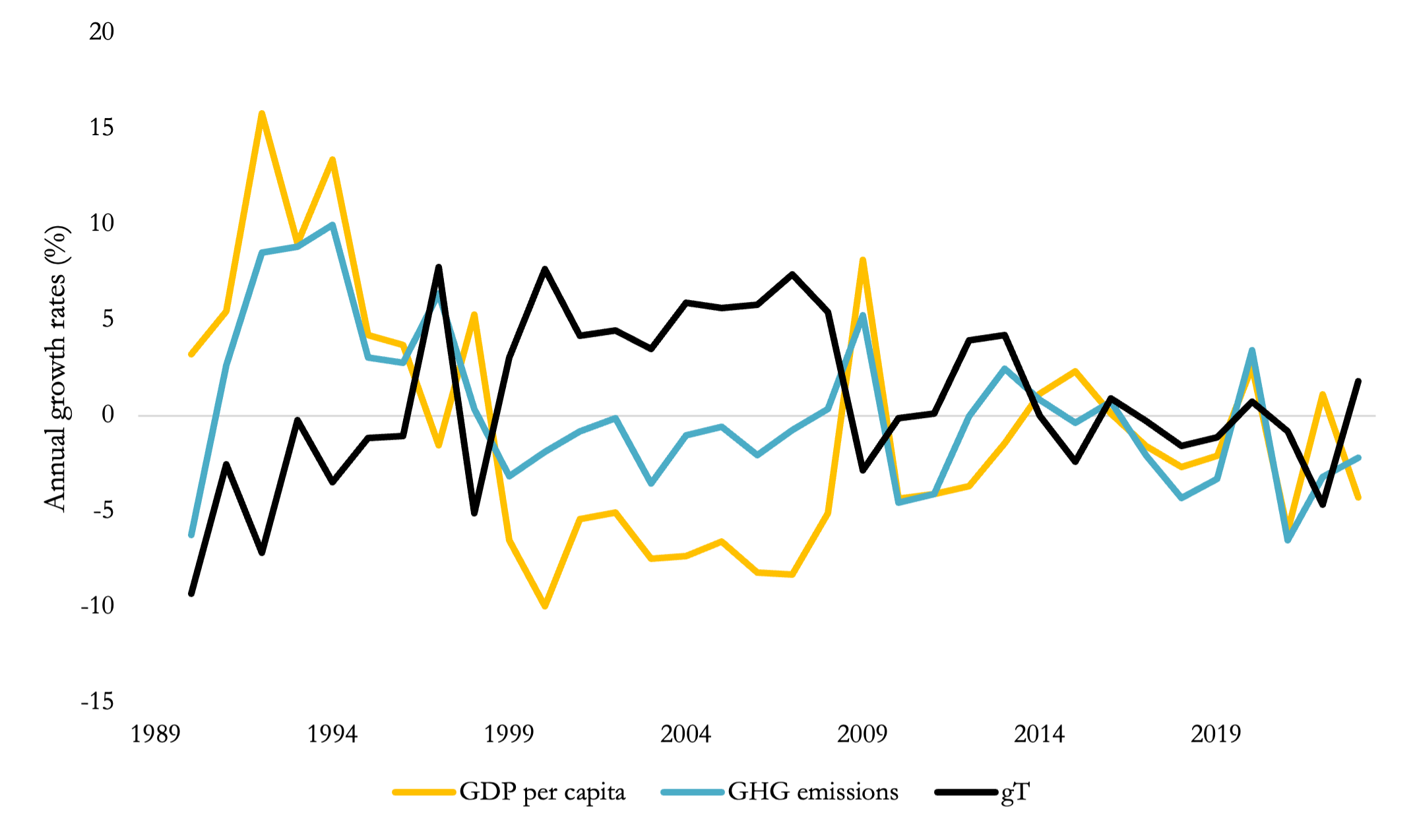
Figure 1. Average Annual Growth Rate of IPAT forces.
Data were
collected from the
World Bank (2025), and average annual growth rates were calculated for P (population — Population, total -
SP.POP.TOTL), A (affluence — GDP per capita [current LCU] — NY.GDP.PCAP.CN), GHG emissions (I in the IPAT
analysis — Total greenhouse gas emissions excluding LULUCF per capita [t CO2e/capita] —
EN.GHG.ALL.PC.CE.AR5), and T (carbon intensity). Population data were omitted for increased legibility as they
were not major drivers.
The collapse of the Soviet Union in 1991 caused a major contraction of the Russian economy, resulting in a large drop in affluence and emissions (Brizga et al., 2013), as well as a notable drop in carbon intensity due to reduced production and industry shutdowns, although carbon intensity rebounded almost immediately, rising again as affluence continued to fall more rapidly than GHG emissions. Across the 15 post-Soviet republics—Armenia, Azerbaijan, Belarus, Estonia, Georgia, Kazakhstan, Kyrgyzstan, Latvia, Lithuania, Moldova, the Russian Federation, Tajikistan, Turkmenistan, Ukraine, and Uzbekistan—there was a drop in both GDP per capita and GHG emissions of 35% (Brizga et al., 2013).
As the Russian economy attempted to shift toward a free-market economy, it encountered major challenges that led to this economic downturn. Due to failures and a lack of effort to ensure effective political and social reforms alongside economic reform, the Russian economy struggled to establish itself in the free market, instead remaining stifled by political structures, societal mafias, and the oligarchic control of most economic sectors (Bradley & Eberle, 2024). This transition period could have had a very different outcome had the global actors made greater efforts to support Russia in becoming a productive economic partner, as opposed to being content to simply watch the collapse unfold (Bradley & Eberle, 2024).
During this time, Russia and other former Soviet republics entered an era of de-modernization, in which their levels of economic activity, urbanization, industrialization, and international trade saw a notable decline (York, 2008). This era of de-modernization had clear environmental implications. While many developed and developing countries have seen consistent rises in GHG emissions due to modernization, the former Soviet Union experienced the opposite: years of de-modernization led to a steady decline in GHG emissions as society attempted—and in many cases failed—to restructure and transition to an effective free-market economy (Bradley & Eberle, 2024; York, 2008).
The failure of Russia to convert to an effective free-market economy during the fall of the Soviet Union resulted in a decline in affluence (Figure 1). Based on an IPAT analysis, the fall in affluence (A) and GHG emissions caused an initial reduction in carbon intensity; however, it rose again quickly as affluence declined faster than emissions. This period was followed by the eventual recovery in the early 2000s. As the country adjusted, it saw a steady rise in affluence, which drove a rise in emissions, with carbon intensity growth remaining fairly high due to the fact that Russia’s economy was, and remains, primarily driven by fossil fuels (IEA, 2023).
The 2008 global financial crisis led to the second prominent drop in affluence, and a corresponding drop in emissions (Figure 1). The crisis caused a sharp contraction in Russia’s GDP and real incomes, followed by a slow and incomplete recovery. Investment activity dropped, and quality of life stagnated for several years (Voskoboynikov, 2017). Russia’s heavy reliance on oil and gas as its primary exports was both the cause of this economic downturn and a buffer against even worse impacts during the global financial crisis (Gaddy & Ickes, 2010). Although they saw a sharp drop in affluence due to this reliance, Russia continued to depend on oil and gas to support its economy; thus, the health of their economy continues to rely heavily on the global energy markets (Gaddy & Ickes, 2010). Russia also suffered from a decline in technological development, with investment shifting away from machinery and technology, toward simple construction, and a decline in research and development wages, reducing Russia’s technological advancement (Voskoboynikov, 2017). As the global economy recovered from the 2008 financial crisis, Russia saw its main economic forces stabilize through the 2010s, with occasional rises in affluence that were accompanied by efficiency and structural changes that led to a simultaneous drop in carbon intensity, which offset the rises in affluence (Figure 1).
Like many countries, Russia saw a decline in affluence and emissions during the global Covid-19 pandemic. This “Covid shock” occurred worldwide as many industries—particularly service sectors—were placed on hold in an attempt to slow the spread of the virus (Sanghi et al., 2021). Russia saw a 3% drop in GDP, which was less than the approximate 5% drop seen by most advanced and commodity-exporting economies; yet still sufficient to trigger the emissions decline shown in Figure 1 (Sanghi et al., 2021). The global economy, Russia included, also saw economic disruptions due to reduced international trade and meager incomes in the global market, resulting in a drop in affluence around the globe (Mishra et al., 2020). As pandemic measures began to lift, Russia saw a recovery in affluence and a rise in emissions. However, this increase was also driven by Russia’s war with Ukraine, driving emissions higher while also affecting GDP dynamics and prompting sanctions that impact affluence and carbon intensity. These factors likely contributed to the most recent affluence decline and increase in carbon intensity and emissions illustrated in Figure 1 (Lakhani, 2024).
Russia has seen extreme shifts in the IPAT forces since the late 1980s, caused by several local and global economic crises. Russia’s greenhouse gas emissions (I) have been shaped primarily by major local events (the collapse of the Soviet Union and the war with Ukraine) and global events (the 2008 financial crisis and the Covid-19 pandemic), which together have been the primary drivers of change in Russia’s total greenhouse gas emissions.
The author contributed to the concept, writing, and editing of this paper and takes full responsibility for its content, accuracy, and integrity. The author acknowledges the use of ChatGPT and Consensus AI as tools that provided insights into the topic and supported readability and language. All errors, biases, and omissions remain the author’s, not the AI tools’.
Bradley, T. L., & Eberle, P. B. (2024). The Russian Economic Environment and the Collapse of the Soviet Union: A Retrospective Look. Review of Economic & Business Studies, 17(1), 127–157. https://doi.org/10.47743/rebs-2024-1-0006
Brizga, J., Feng, K., & Hubacek, K. (2013). Drivers of CO2 emissions in the former Soviet Union: A country level IPAT analysis from 1990 to 2010. Energy, 59, 743–753. https://doi.org/10.1016/j.energy.2013.07.045
Gaddy, C. G., & Ickes, B. W. (2010). Russia after the global financial crisis. Eurasian Geography and Economics, 51(3), 281–311. https://doi.org/10.2747/1539-7216.51.3.281
IEA (2023). Russia - Energy Mix. IEA. https://www.iea.org/countries/russia/energy-mix
Lakhani, N. (2024, June 13). Russia’s war with Ukraine accelerating global climate emergency, report shows. The Guardian. https://www.theguardian.com/environment/article/2024/jun/13/russia-war-with-ukraine-accelerating-global-climate-emergency-report-shows
Mishra, N. P., Das, S. S., Yadav, S., Khan, W., Afzal, M., Alarifi, A., kenawy, E.-R., Ansari, M. T., Hasnain, M. S., & Nayak, A. K. (2020). Global impacts of pre- and post-covid-19 pandemic: Focus on socio-economic consequences. Sensors International, 1, 100042. https://doi.org/10.1016/j.sintl.2020.100042
Sanghi, A., Freije-Rodriguez, S., & Umapathi, N. (2021, June 8). How has Russia’s economy fared in the pandemic era? World bank Group. https://www.worldbank.org/en/news/opinion/2021/06/08/how-has-russia-s-economy-fared-in-the-pandemic-era
Voskoboynikov, I. (2017). Sources of long run economic growth in Russia before and after the global financial crisis. Russian Journal of Economics, 3, 348-365. https://doi.org/10.1016/j.ruje.2017.12.003
World Bank (2025). Russian Federation. [Data Set]. World Bank Group. https://data.worldbank.org/country/russian-federation
York, R. (2008). De-carbonization in former Soviet republics, 1992–2000: The Ecological Consequences of de-modernization. Social Problems, 55(3), 370–390. https://doi.org/10.1525/sp.2008.55.3.370

This work is licensed under a Creative Commons
Attribution-NonCommercial-ShareAlike 4.0
International license