
Canada’s Free-Rider Problem in
Mitigating Climate Change
Thompson Rivers University
This commentary discusses atmosphere and climate stability as a global public good, and provides a brief analysis of Canada’s climate initiatives, carbon emissions, and carbon intensity. Despite Canada’s commitments under international climate agreements, such as the Paris Agreement, adopted in 2015 (United Nations, 2015), and its nationally determined targets of reducing emissions to 40-45% below 2005 levels by 2030 and meeting net zero by 2050 (Government of Canada, 2024), Canada’s climate policies are insufficient to meet these targets. Amongst many other nations, Canada continues to act in its self-interest as a free-rider in global climate mitigation efforts.
As a global public good, climate stability is non-excludable and non-rivalrous. Climate initiatives aimed at achieving net-zero emissions by 2050, by making changes in national policy and investing in greener solutions that are associated with cutting emissions, are financially costly (Murombedzi & Chikozho, 2023). There are economic incentives for individual countries to free-ride, watching as other countries make genuine attempts to lower their carbon emissions, while still enjoying the benefits climate stability offers. This failure to work towards a collaborative solution in order to mitigate the negative effects of climate change weakens the effort of collective action (Bigerna & Micheli, 2025).
A global public good is a resource from which all individuals benefit (Parenteau, 2023). No one is excluded from the benefits of a clean environment, such as fresh air and a clean atmosphere. Global public goods are also non-rivalrous (Parenteau, 2023), meaning that one person’s use of the good does not prevent others from using it too. Similarly, excessive greenhouse gas (GHG) emissions released into the atmosphere greatly contribute to global warming and climate instability, negatively impacting everyone. No one is free from the burden of an unstable climate and global warming. Climate policy, through mitigation and adaptation, can therefore be considered as a global public good, as the benefits of a stable climate and resilience to climate impacts are universal and non-excludable (Carattini et al., 2019).
Despite Canada’s commitments in policy and international agreements to reduce emissions, under both Liberal and Conservative governments, it has consistently failed to meet its targets. Without a substantial enforcement mechanism, noncompliance in meeting these targets carries few consequences. Figure 1 illustrates Canada’s major GHG emissions reduction commitments between 1992 and 2025.
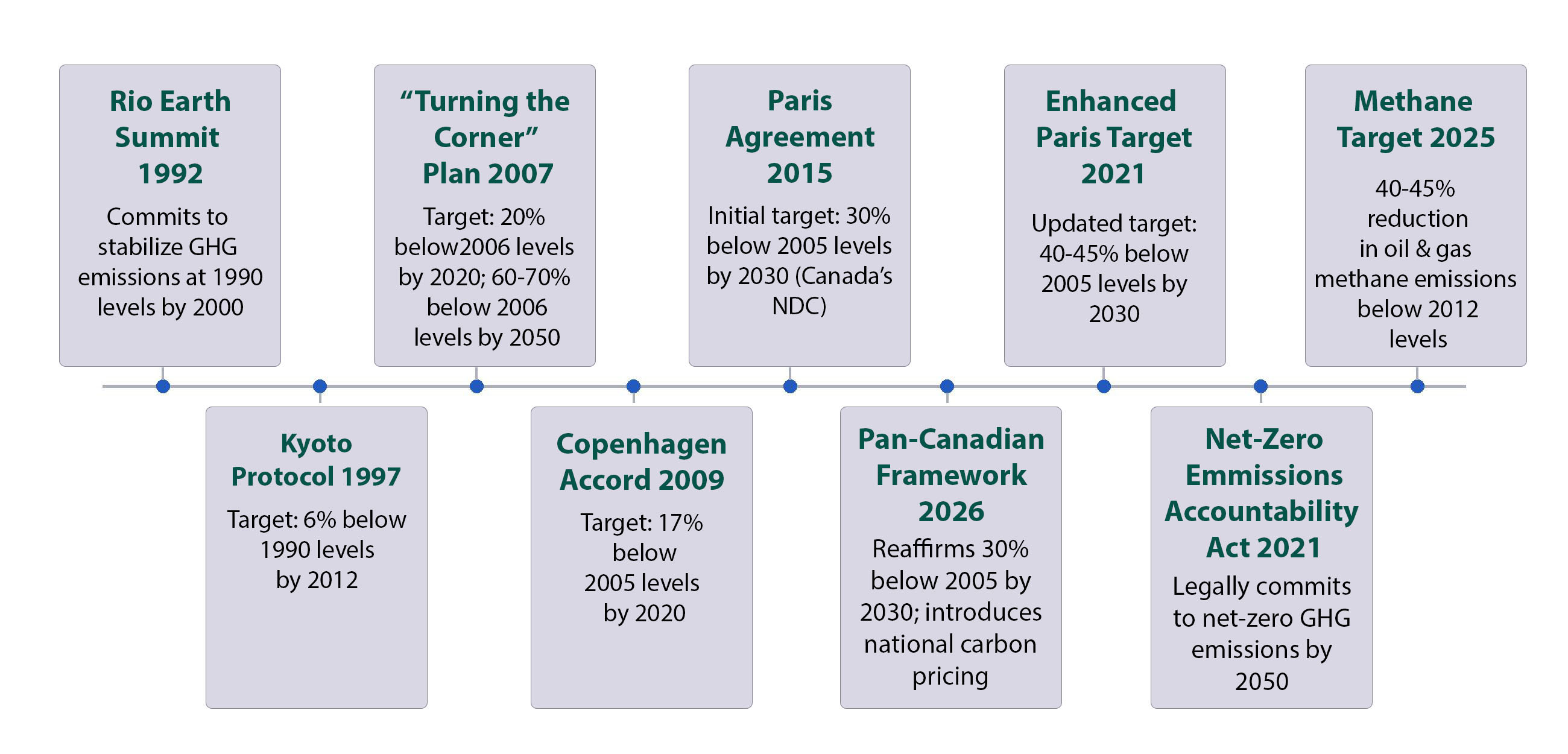
Figure 1:Timeline of major Canadian greenhouse gas emissions targets from
1992 to 2025.
Data from Consensus AI.
Canada emits approximately 14 metric tonnes of carbon dioxide per capita (Our World in Data, 2023), which is far above the global average of ~4.8 tonnes (Our World in Data, 2023). Overall, the country contributes about 1.5% of the global total of carbon emissions, while accounting for just under 2% of global cumulative emissions (Our World in Data< 2023). Canada’s carbon intensity of GDP, according to data from the World Bank Group (2024), is 0.25 kilograms of CO2 equivalent per dollar of GDP in 2024, compared to 0.4 in 1990. This progress shows that, while on one hand, Canada is becoming less carbon intensive in producing output, its national emissions have not fallen over time and still has substantially high emissions per capita. Figures place Canada as the 11th highest emitter (Our World in Data) despite its population, which puts significant pressure on the country to continue climate policy initiatives, cut carbon emissions and collaborate on a global scale. Table 1 shows Canada in comparison to other industrialized nations.
| Indicator | Canada | Germany | United States | Australia |
|---|---|---|---|---|
| CO2 Emissions Per Capita (2023) | 14 t/person | 7.1 t/person | 14.3 t/person | 14.5 t/person |
| Share of Global Annual Emissions | 1.50% | 1.60% | 13% | 1% |
| Share of Cumulative Emissions | ~2% | ~5.2% | ~23.8% | ~1.1% |
| Carbon Intensity of GDP (1990) CO2e/USD | 0.40 kg | 0.3 kg | 0.45 kg | ~0.45 kg |
| Carbon Intensity of GDP (2023) CO2e/USD | 0.25 kg | 0.11 kg | 0.19 kg | 0.23 kg |
Note. Data from the Our World in Data
One potential solution for overcoming the incentives associated with free-riding is the creation of climate clubs. Unlike international treaties and agreements like the Kyoto Protocol and the Paris Agreement, which lack strong enforcement mechanisms (Carattini et al., 2019), clubs are voluntary coalitions that employ incentives and penalties to make a public good, climate policy, excludable (Nordhaus, 2015). Members agree to coordinated policies, such as carbon pricing and cap-and-trade systems, while nonmembers face penalties, typically through tariffs or sanctions (Nordhaus, 2015; Clausing & Wolfram, 2023). The costs of free-riding are outweighed by the benefits associated with joining a club.
Canada is a member of the Climate Club, which is a climate initiative focused on industrial decarbonization (Climate Club, 2024). According to the Climate Club’s 2024 Annual Report, the organization comprises 43 members representing a diverse range of industrial exporters, 62% of global GDP, and 25% of industrial emissions (p. 3). While its long-term effectiveness in meeting Paris Agreement targets remains uncertain, the Climate Club plays an active role in shaping climate policy, strengthening global cooperation, and setting decarbonization standards. In doing so, it shifts climate mitigation from a purely public good toward a club good.
I acknowledge the use of ChatGPT (OpenAI) to support research for this assignment, prompting the tool to provide resources explaining climate policy as a public good, and creating a timeline of major Canadian federal greenhouse gas emissions targets. The outputs were reviewed, adapted, and supplemented with additional research to produce the final written response and Figure 1.
Bigerna, S., & Micheli, S. (2025). Global costs of US withdrawal: Quantifying the impact on Paris Agreement cooperation. Journal of Environmental Management, 392, Article 126733 https://doi.org/10.1016/j.jenvman.2025.126733
Carattini, S., Levin, S., & Tavoni, A. (2019). Cooperation in the climate commons. Review of Environmental Economics and Policy, 13(2), 227247. https://doi.org/10.1093/reep/rez009
Clausing, K. A., & Wolfram, C. (2023). Carbon border adjustments, climate clubs, and subsidy races when climate policies vary. Journal of Economic Perspectives, 37(3), 137–162. https://doi.org/10.1257/jep.37.3.137
Climate Club. (2024). Climate Club 2024 annual report [PDF]. https://climate-club.org/wp-content/uploads/2025/01/2024-Annual-report-Final-31.01-docx.pdf.
Government of Canada. (2025). Global greenhouse gas emissions. https://www.canada.ca/en/environment-climate-change/services/environmental-indicators/global-greenhouse-gas-emissions.html
Government of Canada. (2024). Net-zero emissions by 2050. https://www.canada.ca/en/services/environment/weather/climatechange/climate-plan/net-zero-emissions-2050.html
Murombedzi, J., & Chikozho, C. (2023). Westphalian sovereignty and the free-rider conundrum in the atmospheric commons: Examining global governance regimes for addressing climate change adaptation. International Journal of the Commons, 17(1), 12–21. https://doi.org/10.5334/ijc.1159
Nordhaus, W. (2015). Climate clubs: Overcoming free-riding in international climate policy. American Economic Review 105(4): 1339–70. http://doi.org/10.1257/aer.15000001
Parenteau, P. (2023). The atmosphere as a global public good. University of St. Thomas Journal of Law and Public Policy (Minnesota), 16(1), 217–240. Available at SSRN: https://ssrn.com/abstract=4398470
Ritchie, H. & Roser, M. (2020). CO2 Emissions. Our World in Data. https://ourworldindata.org/co2-emissions
Ritchie, H., Roser, M., & Rosado, P. (2020) CO₂ and greenhouse gas emissions. Our World in Data. https://ourworldindata.org/co2-and-greenhouse-gas-emissions.
United Nations. (2015). The Paris Agreement. Climate Action. https://www.un.org/en/climatechange/paris-agreement

This work is licensed under a Creative Commons
Attribution-NonCommercial-ShareAlike 4.0
International license