
The Economic Impacts of
Wildfires in British Columbia
Thompson Rivers University
Wildfires are one of the most devastating impacts British Columbia faces every year, representing climate-driven economic challenges for the province (Statistics Canada, 2024). Once thought to be a natural disturbance affecting only forests, this short commentary highlights that wildfires generate a cascading financial burden on the people and industries located in British Columbia. With the increasing severity of wildfires, understanding the economic impacts associated with the wildfire season is of utmost importance for provincial planning, risk mitigation, and long-term climate adaptation. This article highlights the impact on governments, communities, and industries, and how they might mitigate the economic fallout caused by wildfire seasons in British Columbia (Natural Resources Canada, 2024).
Research consistently shows that wildfire costs in British Columbia have escalated over the past decade. Brookes et al. (2021) note that the disruption of historical fire regimes has contributed to recent wildfire activity, driving structural shifts in forest composition and creating persistently high fuel conditions. Furthermore, Liu et al. (2024) highlight that wildfires drastically reduce the amount of harvestable timber and can permanently alter timber harvesting potential in British Columbia (Jacobson et al., 2021). Health impacts also represent a significant economic loss. Haider et al. (2019) estimate substantial financial losses due to smoke-related visibility reduction and respiratory issues associated with smoke inhalation, both of which are heightened during major fire seasons in British Columbia. Altogether, the literature indicates that spending on fire suppression alone underestimates the true cost of the wildfire seasons in British Columbia (Lin, 2022).
Provincial cost data gathered from 2018 to 2024 show year-to-year variation in wildfire costs, but with an overall upward trend (Table 1, Figure 1). The 2024 season required an estimated $769 million in government spending (BC Wildfire Service, 2025a). Wildfire costs grew at an average annual rate of approximately 20% per year from 2018 to 2024, as estimated using a logarithmic linear trend line. Suppression costs ranged anywhere from $216 million in 2019 to a staggering $1.12 billion in 2023 (BC Wildlife Service, 2025a, b). Looking beyond suppression, there are the costs associated with infrastructure, property, and human health. Insured losses caused by wildfires were approximately $737 million in 2023 (Insurance Bureau of Canada, 2024, adjusted to 2024 dollars) and an estimated $637 million in 2024. Health-related costs were calculated using the average annual short-term human health cost adjusted by British Columbia’s share of emissions, showing a minimum of $4 million in 2020 and a maximum of $226 million in 2023 (Canada Health, 2024; UBC Faculty of Medicine, 2023). The property and insurance cost is an estimate based on the Insurance Bureau of Canada's 2023 reported insurance damage extrapolated by total hectares burned. Over the entire 2018–2024 period, the total wildfire cost in British Columbia amounted to approximately $7.64 billion in constant 2024 dollars. To contextualize this burden, this is equivalent to roughly $1,530 per person in the province, assuming an average population of about 5.4–5.5 million (all values are expressed in constant 2024 CAD). These findings show that wildfires are not only environmentally harmful but also generate lasting economic shocks with long-term consequences (United States Forest Service, 2023).
| Year | Suppression | Property & | Health & Air Quality Related | Total |
|---|---|---|---|---|
| 2018 | 742 | 462 | 142 | 1,346 |
| 2019 | 216 | 15 | 5 | 235 |
| 2020 | 227 | 10 | 4 | 241 |
| 2021 | 817 | 582 | 178 | 1,577 |
| 2022 | 438 | 85 | 27 | 550 |
| 2023 | 1121 | 737 | 226 | 2,085 |
| 2024 | 769 | 637 | 196 | 1,603 |
| TOTAL | 4,331 | 2,529 | 778 | 7,638 |
Notes. Property and insured damage costs are approximations derived from annual area burned, historical insured-loss patterns, and available industry claims information. In years without provincial loss data, values are scaled relative to comparable seasons. Health and air-quality impact costs are calculated by applying national wildfire-related health damage estimates to British Columbia’s population share. Relocation, evacuation, and business-disruption costs are based on estimated evacuation counts and typical per-person displacement cost ranges reported in previous fire seasons (Statistics Canada, 2024). Appendix 1 has more details. All values are converted to constant 2024 Canadian dollars: https://www150.statcan.gc.ca/t1/tbl1/en/tv.action?pid=1810000501
Other factors, such as timber loss, also account for significant economic impacts. In 2024, approximately 20.4 million m³ of merchantable timber was burned, generating an estimated value between $0.49 billion and $1.93 billion, depending on salvage rates and market conditions (BC Ministry of Forests, 2025). The findings from our research align with Natural Resources Canada’s national cost assessments, showing that wildfire-related spending has regularly exceeded $1 billion annually. The trend of higher suppression costs indicates that reactionary strategies are becoming more expensive under longer and hotter fire seasons. Timber loss exposes the fragility of British Columbia’s forestry sector, while health and property costs extend the economic impact beyond suppression and timber loss values. Vulnerable communities are disproportionally affected, reinforcing themes identified by Copes-Gerbitz et al. (2022).
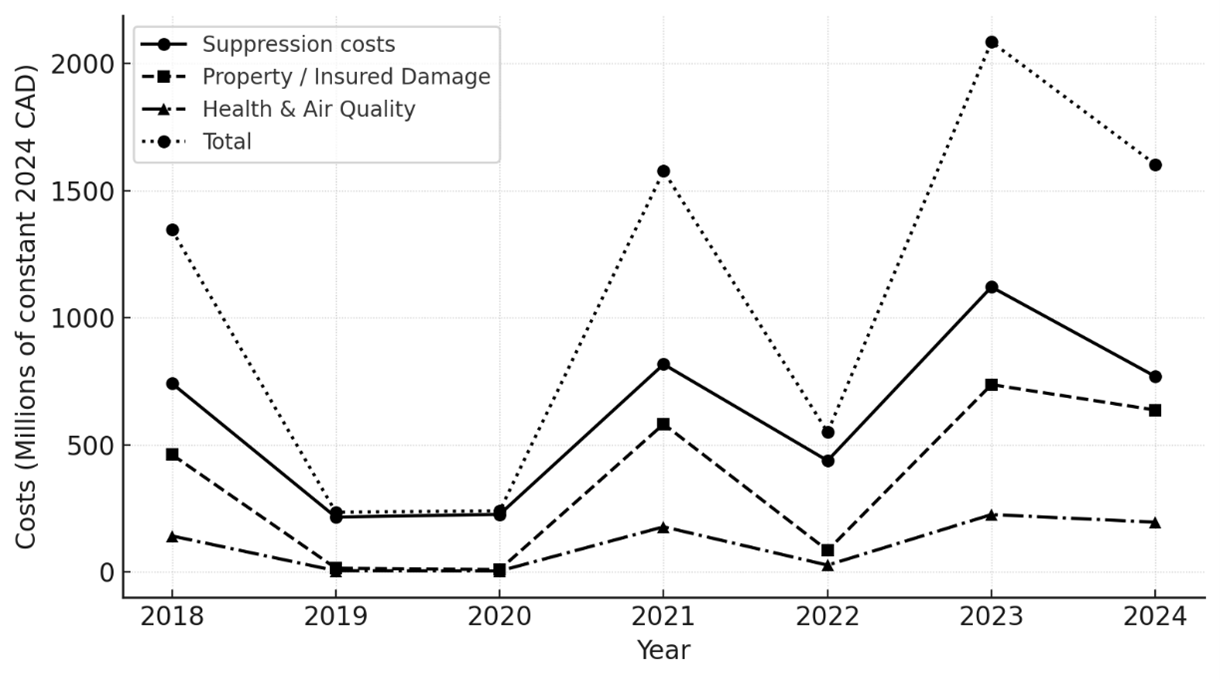
Figure 1: Wildfire-related costs in British Columbia, 2018–2024 (millions
of constant 2024 CAD).
Figure created using Python.
Wildfires in British Columbia generate a multitude of economic costs that consistently exceed suppression budgets. The province should implement strategies to reduce long-term damage, such as fuel-management measures and prescribed burning. Strengthening community evacuation systems, improving air quality readiness, and integrating an economic cost model into the provincial climate strategy would provide more accurate budgeting and enhance resilience. Recognizing wildfires as a recurring economic event is essential for building an effective, forward-looking environmental and economic strategy.
BC Ministry of Forests. (2025, March). Impacts of 2024 fires on forests and timber supply in British Columbia. Province of British Columbia. https://www2.gov.bc.ca/assets/gov/farming-natural-resources-and-industry/forestry/stewardship/forest-analysis-inventory/impacts_2024_fires.pdf
BC Wildfire Service. (2025a). Wildfire season summary – 2024. Province of British Columbia. https://www2.gov.bc.ca/gov/content/safety/wildfire-status/about-bcws/wildfire-history/wildfire-season-summary
BC Wildfire Service. (2025b). Wildfire historical statistics (2014–2024). Province of British Columbia. https://www2.gov.bc.ca/gov/content/safety/wildfire-status
Brookes, W., Daniels, L., Copes-Gerbitz, K., Baron, J., & Carroll, A. (2021). A disrupted historical fire regime in central British Columbia. Frontiers in Ecology and Evolution, 9, 676961. https://doi.org/10.3389/fevo.2021.676961
Canadian Climate Institute. (2024, July 23). Fact sheet: Climate change and wildfires in Canada. https://climateinstitute.ca/news/fact-sheet-wildfires/
Copes-Gerbitz, K., Hagerman, S. M., & Daniels, L. D. (2022). Transforming fire governance in British Columbia, Canada: An emerging vision for coexisting with fire. Regional Environmental Change, 22, Article 48. https://doi.org/10.1007/s10113-022-01895-2
Government of Canada. (2025, February 6). Government of Canada funding for the 2024 wildfire season in Parks Canada administered places, including Jasper National Park wildfire response, recovery, and interim housing. https://www.canada.ca/en/parks-canada/news/2025/02/government-of-canada-funding-for-2024-wildfire-season-in-parks-canada-administered-places-including-jasper-national-park-wildfire-response-recovery.html
Haider, W., Knowler, D., Trenholm, R., Moore, J., Bradshaw, P., & Lertzman, K. (2019). Climate change, increasing forest fire incidence, and the value of visibility: Evidence from British Columbia, Canada. Canadian Journal of Forest Research, 49(10), 1181–1192. https://doi.org/10.1139/cjfr-2018-0309
Health Canada. (2024). Human health effects of wildfire smoke. Canada.ca. https://www.canada.ca/en/health-canada/services/publications/healthy-living/human-health-effects-wildfire-smoke.html#a3
Insurance Bureau of Canada. (2024). Severe weather insured losses in Canada: 2023 report. https://www.ibc.ca
Jacobson, R., Sokhansanj, S., Roeser, D., Hansen, J., Gopaluni, B., & Bi, X. (2021). Ancillary impacts of harvest residue pelletization. Journal of Sustainable Bioenergy Systems, 11(3), 171–183. https://doi.org/10.4236/jsbs.2021.113011
Lin, T. (2022). Suppressing forest fires in global climate change through artificial intelligence: A case study on British Columbia. Proceedings of the 2022 International Conference on Big Data, Information and Computer Network (BDICN), 432–438. https://doi.org/10.1109/bdicn55575.2022.00086
Liu, M., Greene, G., Axelson, J., Coops, N., Barbeito, I., & Roeser, D. (2024). Influence of irregular shelterwood treatments on intensity and severity after a large wildfire in lodgepole pine stands: A case study from interior British Columbia. PLOS ONE, 19(3), e0311940. https://doi.org/10.1371/journal.pone.0311940
Natural Resources Canada. (2024). Fighting and managing wildfires in a changing climate: Wildland firefighter management program. Government of Canada. https://natural-resources.canada.ca/forest-forestry/wildland-fires/fighting-managing-wildfires-changing-climate-program
Statistics Canada. (2024). Measuring the economic cost of wildfires. Government of Canada. https://www.statcan.gc.ca/o1/en/plus/8369-measuring-economic-cost-wildfires
Statistics Canada. (2024). Wildfire evacuations and displacement in Canada: 2014–2024. Government of Canada.
UBC Faculty of Medicine. (2023). New research examines the health impacts of wildfire smoke exposure. https://www.med.ubc.ca/news/newly-funded-research-examines-health-impacts-of-wildfire-smoke/
US Forest Service. (2023). Wildfire suppression cost reporting: National summary. https://www.fs.usda.gov

This work is licensed under a Creative Commons
Attribution-NonCommercial-ShareAlike 4.0
International license