
Online
ISSN 2819-7046
SPECIAL ISSUE: ECONOMICS OF CLIMATE
CHANGE
2026
Why International Climate
Agreements Are Hard to Enforce
International climate agreements aim to coordinate global action on climate change, yet most have struggled to deliver meaningful emissions reductions. Treaties such as the Kyoto Protocol and the Paris Agreement seek to limit carbon emissions, but enforcement remains weak due to unequal economic incentives, limited penalties, and national self-interest. These challenges are intensified by financial disparities, leading many countries, especially major emitters, to prioritize short-term growth over long-term climate goals. Our research examines how these factors undermine coordination and produce inefficient outcomes, and it identifies economic and political mechanisms needed to ensure broad, enforceable participation in global emissions reduction.
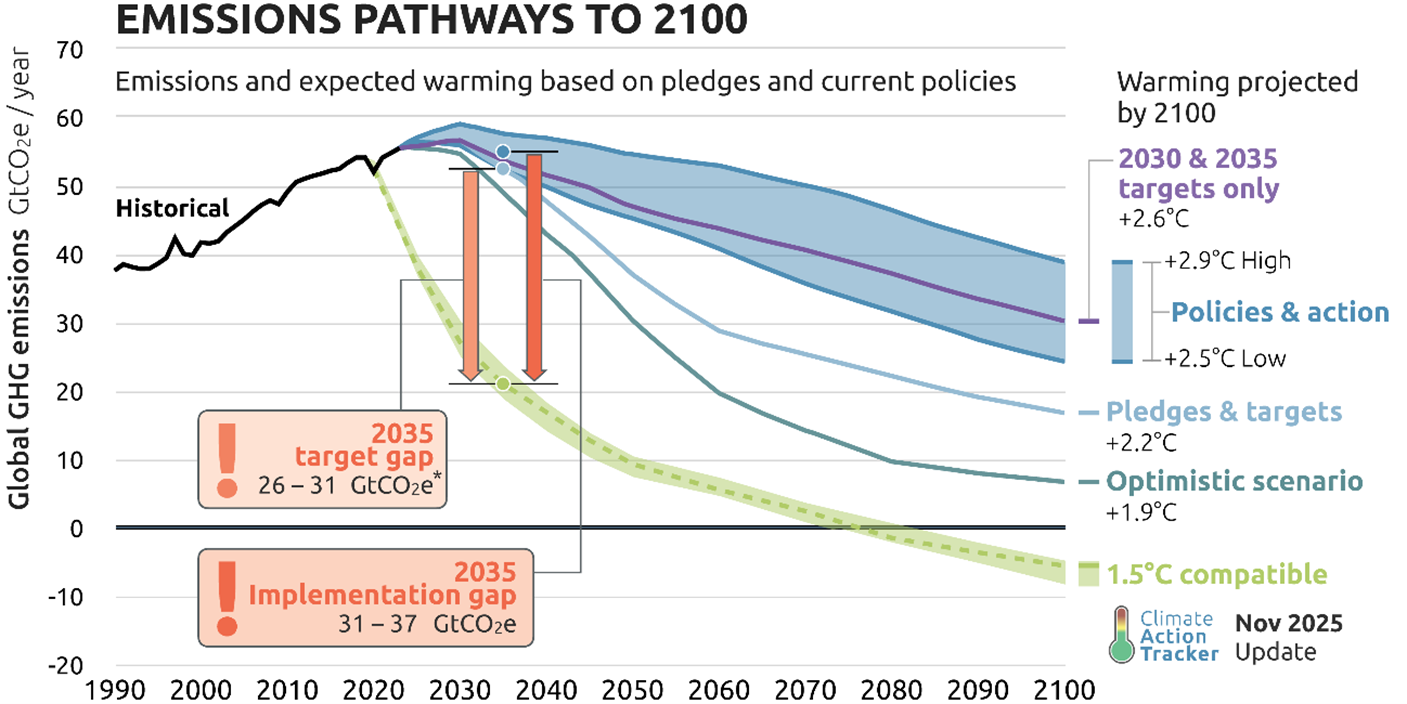
Figure 1: Emissions Pathways to 2100
Source: Climate Action Tracker (2025) © 2009–2026 Climate Analytics and NewClimate Institute.
Used with
permission; non-commercial academic use only.
Long Description
When it comes to climate change, it is easy for nations to set ambitious goals, but even easier for them to avoid taking real action. Figure 1 illustrates different emissions pathways and the corresponding temperature outcomes the world is heading toward. Each pathway demonstrates the type of future we could face depending on the level of commitment from nations. With current policies in place, the world is projected to reach 2.6°C of warming, far above the 1.5°C goal set in the Paris Agreement. Even with the promises made by nations to reduce emissions by 2030/2035, projected warming remains largely unchanged, showing that near-term commitments are insufficient to alter our trajectory.
Looking at long-term commitments, even if countries fulfilled all their stated national targets, warming would still reach about 2.2°C. Only under an optimistic scenario, in which every nation achieves its net-zero goals and significantly strengthens implementation, would warming fall to around 1.9°C. This makes it clear that the world is still far from the 1.5°C pathway.
Table 1 demonstrates that no nation has a strong incentive to collaborate or show genuine political will. Climate agreements rely heavily on voluntary participation, which encourages free-riding. As Gupta and van Deursen (2025) note, the Paris Agreement was explicitly designed around nationally determined contributions (NDCs) rather than binding requirements, leaving transparency as the primary accountability mechanism. In the absence of sanctions, major emitters can postpone decisive action without facing tangible consequences.
| Problem | What It Means | Why It Undermines Agreements |
|---|---|---|
| Free-riding & No Penalties | Participation and targets are voluntary, no enforcement for noncompliance. Gupta and van Deursen (2025). | Major emitters can delay action without consequences, creating classic collective-action failure. |
| Weak Political Institutions & Accountability | Effectiveness of transparency and “naming and shaming” depends on domestic institutions. Dannenberg et al. (2023) | Only countries with strong courts, media, and democratic accountability respond, weak-governance states ignore reputational pressure. |
| Capacity & Implementation Gap | Countries adopt ambitious NDCs but lack bureaucratic, technical, or financial capacity to execute them. (Peterson & van Asselt, 2025). | Even supportive governments fail to implement policies, causing persistent gaps between commitments and real mitigation. |
| Inequality Between Countries | Developing states face high costs and limited resources; developed states have historic responsibility but uneven leadership. (Mracvocá, 2025) | Many developing countries cannot meet NDCs without external support, reducing incentives and trust in the system. |
| Ambition–Compliance Tension | Diplomatic pressure pushes states to announce ambitious pledges they cannot realistically meet. (Stanković et al., 2023) | Unrealistic NDCs lead to weak implementation, backsliding, and declining credibility of the entire agreement. |
Compliance also depends significantly on national political institutions. As Dannenberg et al. (2023) explain, naming and shaming can only be effective where courts, the media, and democratic accountability are strong. In addition, many institutions have brought nations to court for climate change inaction. Both the Urgenda v. Netherlands decision (Environmental Law Alliance Worldwide, 2025), and the KlimaSeniorinnen v. Switzerland case (European Court of Human Rights, 2024) illustrate how national and regional courts can compel governments to strengthen their climate actions, treating inadequate climate policies as potential human rights violations.
Institutional capacity is one of the most persistent structural limitations according to Peterson & van Asselt (2025). Many countries struggle with the implementation of climate policies; consequently, ambitious NDCs, or even well-designed climate policies, cannot deliver major results, especially in countries with insufficient resources or political constraints. This reinforces the idea that weak institutional capacity is a fundamental reason why international climate agreements remain difficult to implement.
The imbalance in the commitments of developed and developing countries has marked climate agreements, according to Mravcová (2025). Developed countries, which typically have greater financial capacity, are historically among the largest emitters yet often fail in mitigation leadership.
Meanwhile, many developing countries remain behind in meeting their climate goals due to gaps in capacities and unequal responsibilities.
At the same time, flexibility within international agreements can undermine credibility. According to Stanković et al. (2023), Chad’s hasty and unrealistic pledge in 2015 and Brazil’s weakening of its NDC illustrate how pressure to increase ambition can lead to politically or economically unfeasible commitments. These dynamics lead to a lack of actual compliance and thus to the failure of international climate agreements by turning them ineffective and unrealistic.
Structural economic incentives, weak political institutions, and global disparities make international climate agreements difficult to enforce. While transparency and diplomatic pressure help, they cannot replace national capacity and binding mechanisms. Without stronger institutions, fairer responsibility frameworks, and real commitment beyond voluntary pledges, global coordination on climate action will remain ineffective. Otherwise, today’s promises risk becoming tomorrow’s regrets.
Future generations will be the ones who pay the price, reflecting a lack of empathy toward future societies. At this point, the real question is whether global leaders are willing to turn their promises into meaningful action. Without stronger cooperation and enforceable commitments, the world will continue drifting away from the goals it agreed to. Our future depends on whether nations choose meaningful action over political rhetoric.
What is missing is a global governing body capable of providing global public goods (e.g., climate stability, pandemic prevention, biodiversity protection, and deep ocean/space governance). Table 2 summarizes five foundational aims of such a body: legitimacy, mandate clarity, effectiveness, accountability, and equity, alongside the institutional conditions that would make each aim operational in practice. Together, these conditions outline the minimal architecture for a global body that is both normatively justified and functionally capable of addressing problems that no nation can solve alone.
| Aim | Required Condition |
|---|---|
|
One-person–one-vote global elections; universal, non-discriminatory voter access; protections against state interference. |
|
Authority restricted to true global public goods (climate, pandemics, space, oceans, and deep seas, global commons) guided by issues that require collective global action. |
|
Ability to raise stable revenue (e.g., carbon levies on global sectors) and impose proportional sanctions for non-compliance. |
|
Open deliberation, documented voting, independent auditing, conflict-of-interest rules, and judicial review mechanisms. |
|
Contribution formulas acknowledging historical responsibility and capacity; guaranteed support for vulnerable and low-income regions; inclusive representation structures. |
Until this occurs, global public goods will be underprovided!
We are deeply grateful to Professor Tsigaris for his guidance, contributions, encouragement, and thoughtful feedback throughout the development of this commentary; his support greatly strengthened our work. We also acknowledge the use of AI assistance (ChatGPT) for editing and improving the clarity of the text. All remaining errors are our own.
Climate Action Tracker. (2025, November 13). Emissions pathways to 2100 [Web page and figure]. Climate Analytics & NewClimate Institute. https://climateactiontracker.org/global/emissions-pathways/
Dannenberg, A., Lumkowsky, M., Carlton, E. K., & Victor, D. G. (2023). Naming and shaming as a strategy for enforcing the Paris Agreement: The role of political institutions and public concern. Proceedings of the National Academy of Sciences, 120(40), e2305075120. https://doi.org/10.1073/pnas.2305075120
Environmental Law Alliance Worldwide (ELAW). (2019). Urgenda Foundation v. The State of the Netherlands. https://elaw.org/resource/urgenda-foundation-v-the-state-of-the-netherlands
European Court of Human Rights. (2024). Verein KlimaSeniorinnen Schweiz and Others v. Switzerland (Application No. 53600/20). Council of Europe. https://hudoc.echr.coe.int/eng/#{%22itemid%22:[%22002-14304%22]}
Gupta, A., & van Deursen, M. (2025). Making transparent the accountability deficit in the global climate regime. NPJ Climate Action, 4, Article 60. https://doi.org/10.1038/s44168-025-00264-z
Mravcová, A. (2025). Assessing the effectiveness of international climate agreements in mitigating global warming. Studia Ecologiae et Bioethicae, 23. https://doi.org/10.21697/seb.5835
Nordhaus, W. D. (2015). Climate clubs: Overcoming free-riding in international climate policy. American Economic Review, 105(4), 1339–1370. https://doi.org/10.1257/aer.15000001
Peterson, L., & van Asselt, H. (2025). Assessing risks to the implementation of NDCs under the Paris Agreement. Climate Policy. https://doi.org/10.1080/14693062.2025.2513023
Stanković, T., Hovi, J., & Skodvin, T. (2023). The Paris Agreement’s inherent tension between ambition and compliance. Humanities and Social Sciences Communications, 10(550). https://doi.org/10.1057/s41599-023-02054-6
Figure 1: Line graph illustrating projected global greenhouse gas (GHG) emissions pathways to the year 2100 and the warming outcomes associated with different climate policy scenarios. The vertical axis shows global emissions in gigatonnes of CO₂ equivalent per year (GtCO₂e/year), while the horizontal axis spans from 1990 to 2100.
A black line represents historical emissions, which rise steadily from roughly 38 GtCO₂e in 1990 to around 55 GtCO₂e by 2020.
Beyond 2020, several projected pathways are shown:
The figure highlights two key gaps in 2035:
Overall, the graphic emphasizes that existing policies and pledges fall well short of the emissions reductions needed to limit global warming to 1.5°C.
Back to Figure 1

This work is licensed under a Creative Commons
Attribution-NonCommercial-ShareAlike 4.0
International license