

Online
ISSN 2819-7046
SPECIAL ISSUE: ECONOMICS OF CLIMATE
CHANGE
2026
IPAT, Emissions Drivers & Economic Growth
Climate policy discussions usually focus on technological innovation as the primary response to climate change. Energy efficiency improvements, renewable energy deployment, and industry decarbonization are frequently cited as paths to long-term economic growth that do not result in increases in greenhouse gas emissions. However, worldwide emissions trends indicate that technological development alone is insufficient to offset the combined effects of expanding population and economic expansion. Using the IPAT identity as an analytical framework, this commentary contends that, while technology has reduced emissions intensity, these gains have been offset by increases in population and affluence, resulting in continued increases in total global GHG emissions (Ehrlich & Holdren, 1971; Chertow, 2001).
The IPAT identity expresses environmental impact (I) as the product of population (P), affluence (A, measured as GDP per capita), and technology (T), which represents emissions per unit of economic output. This paradigm emphasizes that, in order to reduce overall emissions, reductions in technological intensity must be large enough to balance increases in population and income. While technological advancements have reduced emissions per unit of GDP, the IPAT identity predicts that overall emissions will increase if population and wealth growth outpaces technological advancements (Ehrlich & Holdren, 1971; Chertow, 2001).
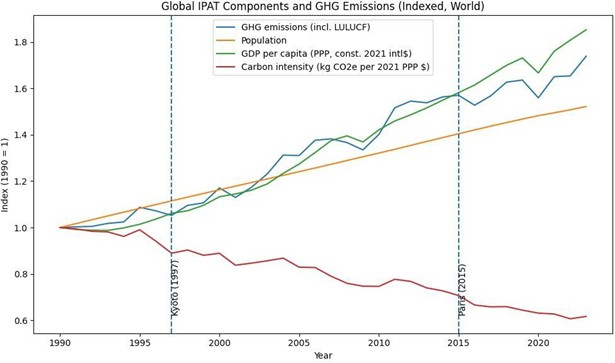
Figure 1. Global IPAT components and greenhouse gas (GHG) emissions, indexed (1990 = 1), world (1990–2023). The series includes total GHG emissions, land use, land-use change and forestry (LULUCF - Mt CO₂e), population, GDP per capita (PPP, constant 2021 international $), and carbon intensity (kg CO₂e per 2021 PPP dollar of GDP). Vertical lines indicate the Kyoto Protocol (1997) and the Paris Agreement (2015). Data source: World Bank World Development Indicators (WDI)/Data360 based on EDGAR.
Figure 1 depicts global trends in GHG emissions (including land use, land-use change, and forestry), population, GDP per capita, and carbon intensity between 1990 and 2023. Global GHG emissions have increased by over 80% since 1990, reaching nearly 60 gigatonnes of CO2 equivalent in recent years. At the same time, global population and GDP per capita have continuously increased, demonstrating robust growth in both the population and affluence components of IPAT. Carbon intensity fell by almost 40% over the same period, indicating substantial technological development.
However, this decrease was inadequate to offset the combined effects of population growth and increased prosperity, resulting in further increases in total emissions.
This figure also highlights two significant international climate agreements: the Kyoto Protocol (1997) and the Paris Agreement (2015). While these accords are significant milestones in global climate policy, the data reveal no persistent drop in total global GHG emissions following either agreement. Emissions growth reduced in some areas, but overall emissions continued to rise after Kyoto and Paris. This finding is consistent with the IPAT paradigm, which indicates that policy commitments and efficiency gains alone are unlikely to result in absolute emissions reductions unless they directly restrain population growth, consumption, or energy demand.
The continuation of rising emissions despite declining carbon intensity demonstrates a well-documented weakness of technology-based mitigation measures. Energy efficiency improvements can reduce the effective cost of energy services, resulting in increased demand and partially offsetting emissions reductions—a phenomenon known as the rebound effect (Brännlund et al., 2007). As a result, technological advances frequently slow rather than reverse emissions growth. According to IPAT, this outcome is expected: reductions in the technology component must outpace increase in both population and prosperity to result in absolute emissions reductions.
Structural constraints limit the rate at which technology can reduce emissions. Land, material inputs, long-distance transmission infrastructure, and energy storage are all required for scalable renewable energy systems. Carbon capture technologies remain expensive and face deployment hurdles at the scale required for global abatement. The Intergovernmental Panel on Climate Change (2022) highlights that demand-side and behavioural adjustments could account for a significant portion of emissions reductions required by mid-century─reductions that technological advancements alone are unlikely to accomplish. Recent research also suggests that even significant industry decarbonization may be insufficient to bring household carbon footprints in line with 1.5°C-compatible pathways without decreases in consumption and energy demand (Cap et al., 2024).
Another disadvantage of relying primarily on technical solutions is policy moral hazard. If governments believe that future innovation will solve climate problems, they may postpone near-term policy actions like carbon pricing, the elimination of fossil-fuel subsidies, and investments in efficiency and low-carbon infrastructure. Policy assessments, including those conducted by the Government of Canada (2021), show that clean technologies are most effective when supported by robust regulatory frameworks and economic incentives. Without such controls, technological advancement tends to reduce emissions intensity while leaving total emissions relatively unchanged.
To summarize, technology is a necessary but insufficient condition for solving climate change. The IPAT identity explains why reducing carbon intensity has not resulted in lower global emissions: population growth and rising affluence (wealth) have overtaken technological improvement. The trends shown in Figure 1 show that, despite worldwide climate agreements and efficiency improvements, overall global GHG emissions have continued to increase. Achieving long-term carbon reductions will require a comprehensive approach that combines technological innovation with strong regulatory measures, demand-side adjustments, and structural modifications to energy and consumption systems.
The author of this paper contributed to the concept, writing, and editing and takes full responsibility for the content, accuracy, and integrity of the work. The author gratefully acknowledges the guidance, editorial feedback, and economic analysis insight provided by Professor Peter Tsigaris, whose support greatly strengthened the clarity and rigor of this commentary. The author also acknowledges the use of ChatGPT as a writing and readability support tool and Consensus AI for assistance with literature review. All errors, biases, and omissions remain the responsibility of the author and not the AI tool or Professor Tsigaris.
Brännlund, R., Ghalwash, T., & Nordström, J. (2007). Increased energy efficiency and the rebound effect: Effects on consumption and emissions. Energy Economics, 29(1), 1–17. https://doi.org/10.1016/j.eneco.2005.05.002
Cap, S., de Koning, A., Tukker, A., & Scherer, L. (2024). (In)sufficiency of industrial decarbonization to reducehousehold carbon footprints to 1.5°C-compatible levels. Sustainable Production and Consumption, 45, 216–227. https://doi.org/10.1016/j.spc.2023.12.031
Ehrlich, P. R., & Holdren, J. P. (1971). Impact of population growth. Science, 171(3977), 1212–1217. https://doi.org/10.1126/science.171.3977.1212
Chertow, M. (2001). The IPAT equation and its variants. Journal of Industrial Ecology, 4(4), 13–29. https://doi.org/10.1162/10881980052541927
Government of Canada. (2021). Clean technology: Targeted regulatory review – Regulatory roadmap. https://natural-resources.canada.ca/corporate/transparency/clean-technology-targeted-regulatory-review-regulatory-roadmap
Intergovernmental Panel on Climate Change. (2022). Climate Change 2022: Mitigation of climate change. Summary for policymakers. https://www.ipcc.ch/report/ar6/wg3/downloads/report/IPCC_AR6_WGIII_SPM.pdf
World Bank. (2024). Carbon dioxide (CO₂) emissions excluding LULUCF per capita (tCO₂/capita). https://data.worldbank.org/indicator/EN.GHG.CO2.PC.CE.AR5

This work is licensed under a Creative Commons
Attribution-NonCommercial-ShareAlike 4.0
International license