
Online
ISSN 2819-7046
SPECIAL ISSUE: ECONOMICS OF CLIMATE
CHANGE
2026
Climate Change as a Global Externality
Climate change is one of the most serious global externalities, and the largest part of its impacts falls on the poorest countries in the world. Low-income nations, which are responsible for only a small portion of the world’s carbon dioxide emissions, suffer the worst economic, social, and environmental effects of climate change. This situation raises an important moral question: who should be held liable for the climate damage that affects poor countries? Moral, financial, and global governance considerations lead to the conclusion that rich and historically high-emission countries should carry a greater share of the global burden.
The developing world has been responsible for only a small fraction of global CO2 emissions, yet it is disproportionately affected by climate change, lacking the resources and infrastructure necessary to build defences against or recover from climate-induced disasters. The ethical principles commonly accepted in the climate justice debate, such as polluter-pays, beneficiary-pays, historical responsibility, and ability-to-pay, place the financial burden on the countries responsible for the problem and on those with the capacity to solve it (Page & Heyward, 2017; Adelman, 2016; Massenberg, 2021). These principles form the basis of the United Nations’ Common but Differentiated Responsibilities (CBDR) doctrine, which maintains that due to economic advantages gained from carbon-intensive industrialization, developed nations have greater obligations than others.
A powerful way to think about fairness in climate policy comes from John Rawls’ theory of justice (Rawls, 1971). Rawls replaces the utilitarian goal of maximizing total or average wellbeing with the difference principle, which states that policies should make the least advantaged group as well off as possible. When applied to climate change, this principle highlights a major ethical concern: those who contributed the least to the problem are suffering the most. Research by Callahan and Mankin (2022) shows that historical emissions from high income regions—such as the United States, Japan, Russia, and the European Union (EU-27) —have caused trillions of dollars in economic losses for low-income countries, while simultaneously increasing wealth in the emitting countries. This aligns directly with Rawlsian concerns about justice and strengthens the moral arguments behind the polluter-pays and ability-to-pay principles embedded in the CBDR framework.
Figure 1 from Callahan and Mankin (2022) illustrates these global inequities: poorer countries (income quintiles 1–2) experience the largest net economic losses from climate change, while the richest countries (quintile 5) see net gains. The colours in the figure identify the income group whose emissions caused the damage, making it clear that high-income emitters dominate global climate impacts despite experiencing fewer negative effects themselves.
The combination of Rawlsian philosophy and empirical climate-damage evidence leads to a consistent conclusion: fair climate policy requires recognizing historical responsibility and addressing unequal impacts, not just as a matter of ethics but also as a matter grounded in measurable economic outcomes.
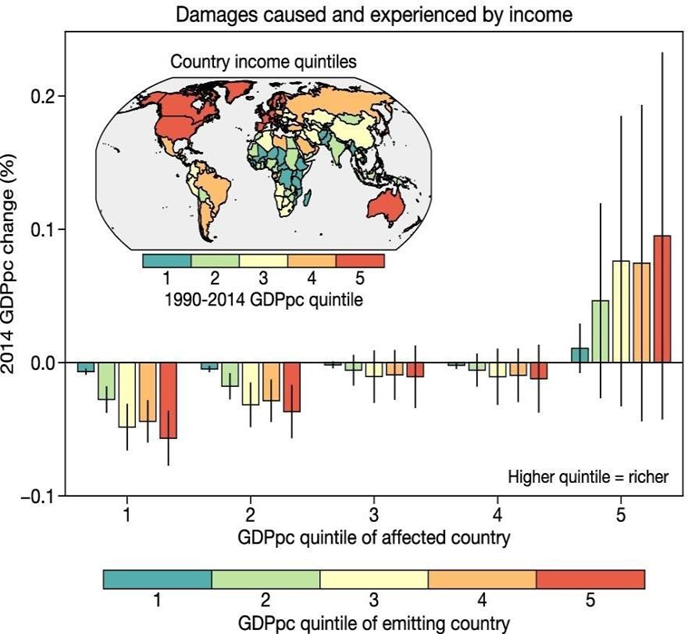
Figure 1. Global distribution of economic damages caused
by historical emissions.
Adapted from Figure 4 in Callahan & Mankin (2022). Used under the CC BY
3.0 license.
Long Description
Although backed by strong empirical and moral arguments, global loss and damage negotiations are still politically divisive. Wealthy countries have been reluctant to agree to force-based compensation systems and have instead favoured charity- or insurance-based approaches. Marginalized states contend that these measures lack accountability, and do not match the gravitas of climate impacts (Gewirtzman et al., 2018; Nand & Bardsley, 2020).
The creation of the Loss and Damage Fund at COP27 and COP28 signifies a step in the right direction; however, fundamental questions, especially regarding contributors and funding levels, remain unresolved. Climate Finance mechanisms, including the Green Climate Fund (GCF), the Global Environment Facility (GEF), and the Climate Investment Funds, were established to support developing countries. Nevertheless, countries with limited administrative capacity often find it difficult to access resources due to bureaucratic, technical, and institutional hurdles (Savvidou et al., 2021).
In addition, global climate finance continues to favour mitigation over adaptation, even though adaptation is often more urgently needed in poor, climate-vulnerable regions. Moreover, financial support from the private sector is usually directed towards profit-making through mitigation, leading to the systematic underfunding of adaptation, a situation often described as "green stripping."
Wealthy countries therefore have a clear historical and moral responsibility to take the lead in bearing the costs of climate damage. Their industrialization was driven by the burning of fossil fuels and resulting emissions, and thus, addressing climate harm is not only an economic matter but a moral and ethical issue as well.
Developing nations' contributions should be based on their present emissions and financial capacities. The climate-finance system must be both fair and effective by delivering predictable and accessible assistance to vulnerable nations, ensuring those who are least to blame for global warming are not made to bear the highest costs. Future global climate action will depend on the extent to which these ethical principles are implemented. With the help of considerable and just resources, long-term resilience can be strengthened, thus reducing the gap between those who are responsible for climate change and those who suffer its consequences.
In preparing this commentary, artificial intelligence (AI) tools were used solely to assist in identifying and retrieving relevant scholarly references. We recognize the use of ChatGPT as a writing and organization tool. It supported the synthesis of peer-reviewed academic research, as well as refining structure for clarity in the commentary. However, no AI-generated text, arguments, or analysis appear in the paper. All writing, reasoning, structure, and conclusions are the original work of the authors. All remaining errors in this document are solely our own.
We would like to acknowledge the valuable support of Professor Peter Tsiggaris’ AI climate economics model, which provided clear, structured explanations of core concepts in climate finance, climate justice, and global public goods. The model offered accessible guidance that helped deepen our understanding of the ethical and economic foundations behind climate-damage responsibility.
Adelman, S. (2016). Climate justice, loss and damage and compensation for small island developing states. Journal of Human Rights and the Environment, 7(1), 32–53. https://doi.org/10.4337/jhre.2016.01.02
Callahan, C. W., & Mankin, J. S. (2022). National attribution of historical climate damages. Climatic Change, 172(3-4). https://doi.org/10.1007/s10584-022-03387-y
Klaser, K., Sacconi, L., & Faillo, M. (2021). John Rawls and compliance to climate change agreements: Insights from a laboratory experiment. International Environmental Agreements: Politics, Law and Economics, 21. https://doi.org/10.1007/s10784-021-09533-8
Gewirtzman, J., Natson, S., Richards, J.-A., Hoffmeister, V., Durand, A., Weikmans, R., Huq, S., & Roberts, J. T. (2018). Financing loss and damage: Reviewing options under the Warsaw International Mechanism. Climate Policy, 18(8), 1076–1086. https://doi.org/10.1080/14693062.2018.1450724
Massenberg, J. R. (2021). Global climate change: Who ought to pay the bill? Sustainability, 13(23), 13393. https://doi.org/10.3390/su132313393
Nand, M. M., & Bardsley, D. K. (2020). Climate change loss and damage policy implications for Pacific Island countries. Local Environment, 25(9), 725–740. https://doi.org/10.1080/13549839.2020.1825357
Page, E. A., & Heyward, C. (2017). Compensating for climate change loss and damage. Political Studies, 65(2), 356–372. https://doi.org/10.1177/0032321716647401
Rawls, J. (1971). A theory of justice. Harvard University Press. https://www.hup.harvard.edu/file/feeds/PDF/9780674000780_sample.pdf
Savvidou, G., Atteridge, A., Omari-Motsumi, K., & Trisos, C. H. (2021). Quantifying international public finance for climate change adaptation in Africa. Climate Policy, 21(8), 1020–1036. https://doi.org/10.1080/14693062.2021.1978053
Stern, N. (2008). The economics of climate change. American Economic Review, 98(2), 1–37. https://doi.org/10.1257/aer.98.2.1
Timilsina, G. R. (2022). Carbon taxes. Journal of Economic Literature, 60(4), 1456–1502. https://doi.org/10.1257/jel.20211560
Figure 1: The figure titled “Damages caused and experienced by income” shows a bar chart illustrating how economic damages associated with emissions are distributed across countries with different income levels.
The vertical axis represents the percentage change in GDP per capita in 2014, with a horizontal line at zero indicating no change. Values below zero represent economic losses, while values above zero represent gains. The horizontal axis represents the income quintile of the affected country, measured by GDP per capita. Quintile 1 represents the lowest-income countries and quintile 5 represents the highest-income countries.
Within each affected-country quintile, five bars represent the income quintile of the emitting country, ranging from lowest-income emitters to highest-income emitters. Thin vertical lines extending from each bar show the uncertainty range associated with the estimate.
The results show a clear distributional pattern. Countries in the lowest income quintile (quintile 1) experience the largest negative changes in GDP per capita, indicating the greatest economic damages. Countries in the second and third quintiles also experience negative impacts, though the magnitude of losses is generally smaller. Countries in the fourth quintile show impacts close to zero, with only small negative changes. In contrast, countries in the highest income quintile (quintile 5) show positive changes in GDP per capita, indicating economic gains associated with emissions-related effects.
An inset world map in the upper left corner provides geographic context by showing the global distribution of country income quintiles based on GDP per capita from 1990 to 2014. Countries are grouped into five income categories corresponding to the quintiles used in the chart.
Overall, the figure demonstrates a strong inequality in impacts: lower-income countries experience greater economic losses, while the wealthiest countries experience smaller losses or net economic gains.
Back to Figure 1

This work is licensed under a Creative Commons
Attribution-NonCommercial-ShareAlike 4.0
International license