
Online
ISSN 2819-7046
SPECIAL ISSUE: ECONOMICS OF CLIMATE
CHANGE
2026
Financing Adaptation in Vulnerable
Nations: Who Pays?
Climate change is one of the most relevant issues facing humanity today and in the future. Climate change is intensifying, and the global temperature anomaly is approaching 1.5°Celsius relative to the pre-industrial period (IPCC, 2023). Climate change has affected many territories around the world, resulting in more frequent extreme events such as flooding, reduced water reserves due to drought, and many other impacts. According to the IPCC, developing countries are disproportionately affected by climate change because they have lower adaptive capacity, weaker institutions, and fewer financial resources, making them more vulnerable to extreme climate events (IPCC, 2022). Low-income nations are the most affected by climate change and are usually the ones that produce the least pollution. Wealthy industrialized nations should provide financial aid to developing ones.
While rich nations benefited from early industrialization, many developing countries lacked the resources to do the same and are now forced to cope with the environmental damage they did not cause. This creates an economic imbalance. Those who profited from pollution owe a debt to those who suffer from its consequences. Wealthy nations should therefore finance adaptation measures in vulnerable regions. Providing such aid is not charity; it is accountability.
The imbalance is evident in the way climate adaptation financing operates in practice. While global discussions emphasize helping vulnerable nations, the actual distribution of funds is far from equitable. The most climate-vulnerable countries do not consistently receive proportionally more support. Nations most in need of adaptation funding often struggle to access it, leaving those who are most at risk with the least support to protect themselves. According to UNDP (2023), countries most vulnerable to climate change face major barriers in accessing adaptation finance, including complex application processes, limited institutional capacity, dependence on intermediaries, and a heavy reliance on loans rather than grants, which increases debt burdens for developing nations. These factors contribute to an inefficient allocation of resources that fails to reach the communities who need it most.
According to the UNEP Adaptation Gap Report 2023, three major gaps appear in the landscape of global adaptation finance. First, actual adaptation funding from developed countries fell far below the estimated needs of USD 215–387 billion annually. Second, only about 17% of adaptation funds directly support projects focused on local communities. Third, just 66% of allocated funds actually reach developing countries. UNDP (2025) states that by 2035, needs in developing countries are projected to exceed USD 310 billion per year─ “12 times as much as current international public adaptation finance flows” (p. 1). Figure 1 illustrates the trend in public adaptation finance from developed to developing countries (2017–2021). The 2025 target was to double the financing from USD 19.2 billion in 2019 to USD 38.4 billion by 2025. However, the latest UNEP Adaptation Gap Report 2025 shows that adaptation finance to developing countries was only USD 26 billion in 2023, well below the USD 38-40 billion goal. Hence, developed nations are providing only around 10% of what is required, meaning that the world is meeting less than one-tenth of what vulnerable countries actually need. Although dedicated climate funds such as the Green Climate Fund, Adaptation Fund, and Global Environment Facility are included in the adaptation finance totals shown in Figure 1, they account for only about 9% of overall public adaptation finance, with most funding instead coming from bilateral donors and multilateral development banks.
Resilience bonds expand this model further, linking financing to adaptation projects such as flood defences or wildfire breaks (Pagano et al., 2020). This shifts climate finance away from merely compensating for loss toward reducing risk proactively.
However, CAT bonds are no silver bullet. They rely on accurate climate modelling, yet extreme events increasingly exceed historical records, complicating pricing and trigger design. Parametric triggers can misfire, either paying out when damages are minimal or failing to release funds when losses are severe. The market also currently advantages developed nations with advanced regulatory data systems. Without support for climate-vulnerable developing countries, CAT bonds could reinforce global climate inequity (Roch et al., 2022).
Despite limitations, the alternative, relying exclusively on traditional insurance, is far more dangerous. Premiums will continue to climb, coverage will contract, and governments will face mounting post-disaster debt. CAT bonds, supported by public climate data and equitable market access, offer one of the few scalable pathways to climate resilience. They mobilise capital quickly, distribute risk broadly, and fund adaptation instead of only compensating damage. As climate volatility accelerates, financial tools must adapt accordingly.
The threat ahead is not uncertainty; it is the risk of meeting 21st-century disasters with 20th-century insurance models. Catastrophe bonds provide a future-ready foundation for climate risk finance.
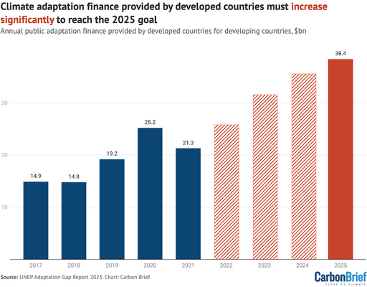
Figure 1. Climate adaptation finance commitments (USD billion per year),
2017–2021 actual and 2022–2025 commitments. Source: UNEP Adaptation Gap Report 2023.
(Chart by Carbon Brief)
CC BY-NC-ND 4.0
Climate change has created a clear imbalance in responsibility and impact. Wealthy nations built their economic power through pollution, while low-income nations now face the worst effects. The current adaptation finance system is failing to support the people who are the most vulnerable. Real financial accountability is necessary if the international community is to ensure that developing nations are not left alone in the climate crisis.
The authors of this paper contributed to the concept, writing, and editing and take full responsibility for the paper’s content, accuracy, and integrity. The authors declares that ChatGPT was used as a tool to support structure, readability, and language clarity. Consensus AI was used for literature review. The table was generated with assistance from ChatGPT based on author-provided data. All errors, biases, and omissions remain the authors’ responsibility, not that of the AI tools.
We thank our professor, Dr. Peter Tsigaris, for helpful comments and guidance on earlier drafts of this paper.
Carbon Brief. (2024). UN report: Five charts that explain the gap in finance for climate adaptation. https://www.carbonbrief.org/un-report-five-charts-which-explain-the-gap-in-finance-for-climate-adaptation/
Canales, N., & Savvidou, G. (2023, February 11). Developing countries require hundreds of billions of dollars in investment every year to help them adapt to the rising threat of climate change [Guest post]. https://www.carbonbrief.org/guest-post-three-major-gaps-in-climate-adaptation-finance-for-developing-countries/
Garschagen, M. (2022). Does funds-based adaptation finance reach the most vulnerable countries? Global Environmental Change, 73, Article 102450. https://doi.org/10.1016/j.gloenvcha.2021.102450
Intergovernmental Panel on Climate Change (IPCC). (2022). Climate change 2022: Impacts, adaptation and vulnerability. Contribution of Working Group II to the Sixth Assessment Report of the IPCC. Cambridge University Press. https://www.ipcc.ch/report/ar6/wg2/
Jodoin, S. (2023, November 28). Guest post: Three major gaps in climate adaptation finance for developing countries. Carbon Brief. https://www.carbonbrief.org/guest-post-three-major-gaps-in-climate-adaptation-finance-for-developing-countries/
Moody’s Analytics. (2024). Global climate finance gap: Key insights for COP29. https://www.moodys.com/web/en/us/insights/data-stories/global-climate-finance-gap-cop29.html
Organisation for Economic Co-operation and Development. (2023). Scaling up adaptation finance in developing countries. https://www.oecd.org/content/dam/oecd/en/publications/reports/2023/11/scaling-up-adaptation-finance-in-developing-countries_4f4b0a0a/b0878862-en.pdf
Stockholm Environment Institute (SEI). (2024). UNEP’s Adaptation Gap Report 2024: Key findings. https://www.sei.org/publications/uneps-adaptation-gap-report-2025/
United Nations Development Programme. (2023). Scaling up adaptation finance in developing countries. UNDP Climate Promise. https://climatepromise.undp.org/news-and-stories/four-key-elements-shaping-future-adaptation-finance
United Nations Development Programme. (2025). Four key elements shaping the future of adaptation finance. UNDP Climate Promise. https://climatepromise.undp.org/news-and-stories/four-key-elements-shaping-future-adaptation-finance
United Nations Environnent Programme. (2023). Adaptation gap report 2023: Underfinanced. Underprepared—Inadequate investment and planning on climate adaptation leaves the world exposed. https://www.unep.org/adaptation-gap-report-2023
United Nations Environment Programme. (2025). Adaptation gap report 2025: Running on empty—The world is gearing up for climate resilience without the money to get there. https://www.unep.org/resources/adaptation-gap-report-2025

This work is licensed under a Creative Commons
Attribution-NonCommercial-ShareAlike 4.0
International license