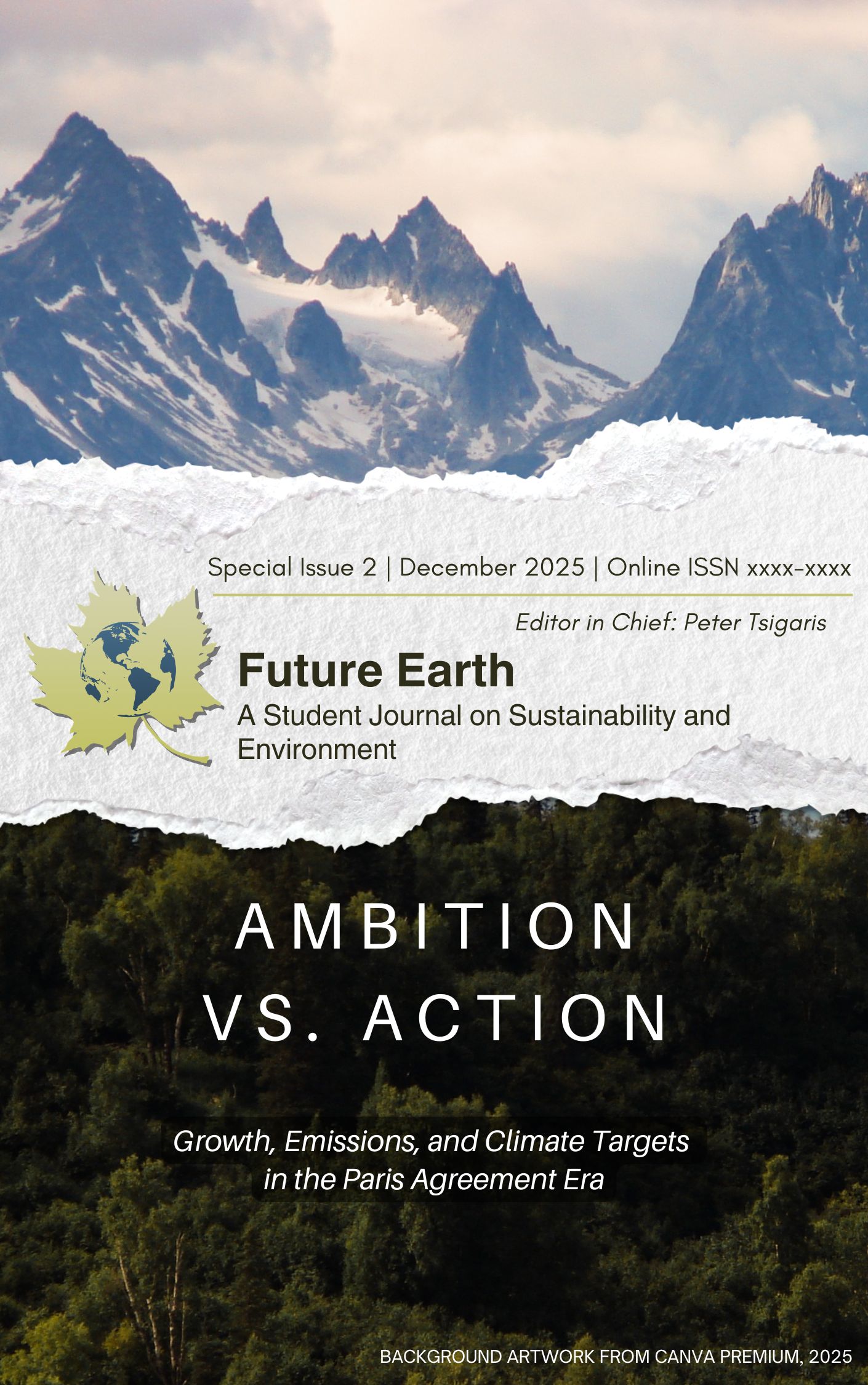
Indonesia’s Economic Growth and Power-Sector Emissions: Development Outpacing Decarbonization
DOI:
https://doi.org/10.29173/bcelnfe724Keywords:
IPAT framework, Indonesia power sector emissions, emissions, Indonesia, carbon intensity, electricity generation, economic growth, Greenhouse Gas (GHG) Emissions, renewable energy, energy transitionReferences
Climate Action Tracker. (2024, December 10). Indonesia https://climateactiontracker.org/countries/indonesia/
Diyono, D., Cappon, H., Kujawa-Roeleveld, K., & Keesman, K. J. (2023). Designing Sustainable Domestic Electricity Supply from Renewable Energy Mixes: Application to Java and Bali, Indonesia. Energies, 16(22), 7461. https://doi.org/10.3390/en16227461
Ehrlich, P. R., & Holdren, J. P. (1971). Impact of Population Growth. Science, 171(3977), 1212–1217.
Holdren, J. P. (1993, September 7). A Brief History of “IPAT” (Impact= Population x Affluence x Technology). MAHB; Stanford University. https://mahb.stanford.edu/library-item/a-brief-history-of-ipat-impact-population-x-affluence-x-technology/
International Energy Agency. (n.d.). Indonesia - Countries & Regions. IEA. Retrieved September 24, 2025, from https://www.iea.org/countries/indonesia/emissions
Setiawan, A., Mardha Mentari, D., Firmansyah Hakam, D., & Saraswani, R. (2025). From Climate Risks to Resilient Energy Systems: Addressing the Implications of Climate Change on Indonesia’s Energy Policy. Energies, 18(9), 2389–2389. https://doi.org/10.3390/en18092389
Statista. (2025, August 5). Twenty countries with the largest population in 2025. https://www.statista.com/statistics/262879/countries-with-the-largest-population/
World Bank. (n.d.-a). Indonesia Data. Retrieved September 15, 2025, from https://data.worldbank.org/country/indonesia
Published
How to Cite
Issue
Section
Categories
License
Copyright (c) 2026 Future Earth: A Student Journal on Sustainability and Environment

This work is licensed under a Creative Commons Attribution-NonCommercial-ShareAlike 4.0 International License.
Authors retain copyright and grant the journal the right of first publication, with the work licensed under a Creative Commons Attribution-NonCommercial-ShareAlike (CC BY-NC-SA) License. This license allows others to share and adapt the work, provided proper attribution is given to the original author and the work's initial publication in this journal, and that it is used for non-commercial purposes under the same terms. Authors may also enter into separate, additional agreements for the non-exclusive distribution of the journal's published version of the work (e.g., posting it to an institutional repository or including it in a book), with proper acknowledgement of its original publication in this journal.
Authors are encouraged to post their work online (e.g., in institutional repositories or on their personal websites) both prior to and during the submission process, as this can foster productive exchanges and increase the visibility and citation of their work (See The Effect of Open Access).