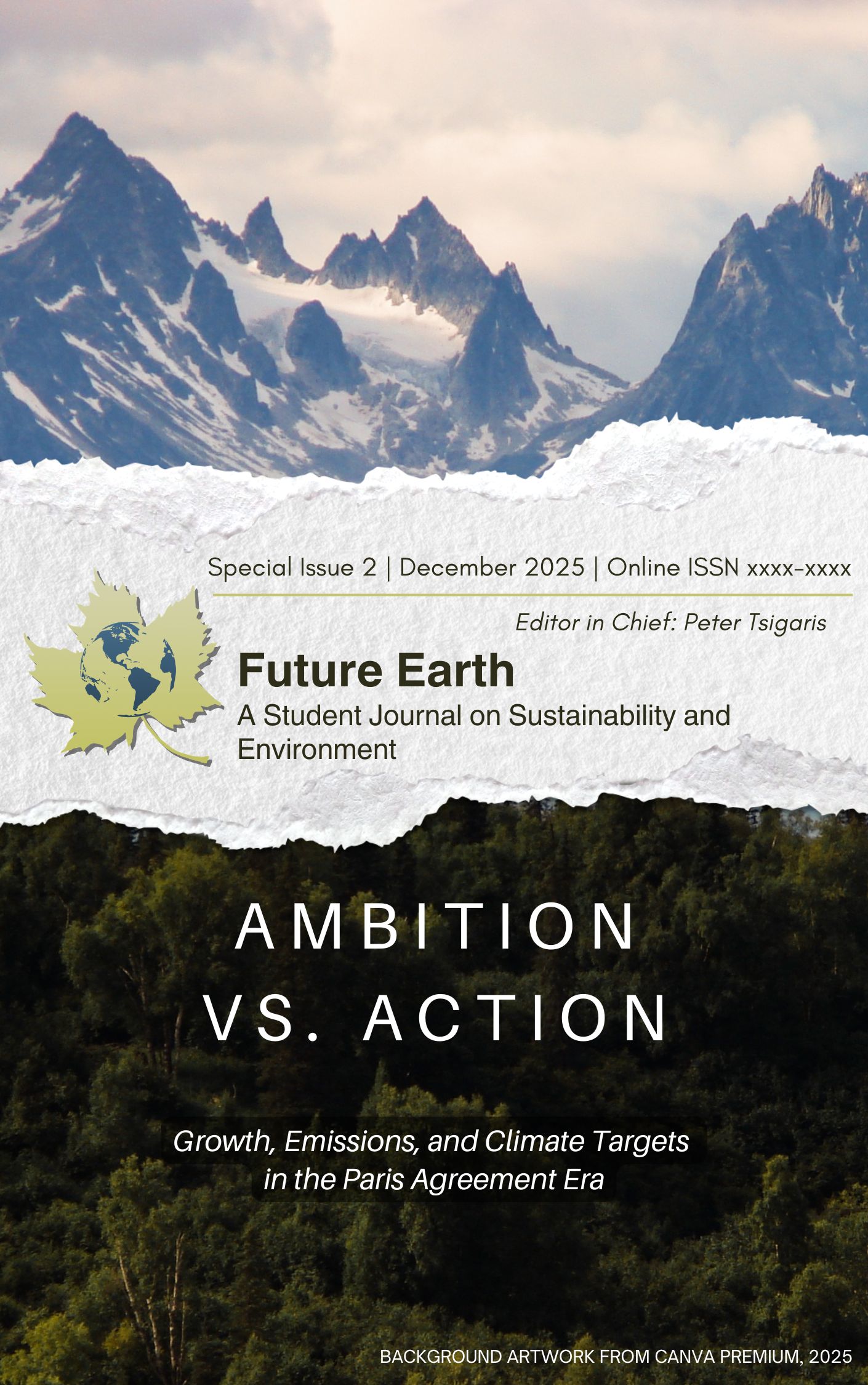
Mexico’s Greenhouse Gas Emissions in the Paris Era: Stabilization Without Sustained Decline
DOI:
https://doi.org/10.29173/bcelnfe738Keywords:
Mexico, greenhouse gas (GHG) emissions, IPAT framework, carbon intensity, decoupling, Paris Agreement, climate policy, Nationally Determined Contributions (NDCs), decarbonization, net-zero, greenhouse gas (GHG) intensity, IPAT decomposition, GDP per capita, emissions trends, economic growthReferences
Abbas, A. (2025). Decoupling economic growth from energy consumption: Review of global trends and policy implications. Habitable Planet 1(1&2), 157170. https://doi.org/10.63335/j.hp.2025.0013
Alemán-Nava, G. S., Casiano-Flores, V. H., Cárdenas-Chávez, D. L., Díaz-Chavez, R., Scarlat, N., Mahlknecht, J., Dallemand, J.-F., & Parra, R. (2014). Renewable energy research progress in Mexico: A review. Renewable and Sustainable Energy Reviews, 32, 140153. https://doi.org/10.1016/j.rser.2014.01.004
Buira, D., Tovilla, J., Farbes, J., Jones, R., Haley, B., & Gastelum, D. (2021). A whole-economy deep decarbonization pathway for Mexico. Energy Strategy Reviews, 33. https://doi.org/10.1016/j.esr.2020.100578
Engström, E., & Kolk, M. (2024). Projecting environmental impacts with varying population, affluence and technology using IPAT – Climate change and land use scenarios. In Vienna Yearbook of Population Research 2024, 22, 129. https://doi.org/10.1553/P-N5EN-Z38A
García Hernández, A. L., & Lucatello, S. (2021). Climate policy integration: taking advantage of policy windows? An analysis of the energy and environment sectors in Mexico (1997–2018). Journal of Environmental Policy & Planning, 24(1), 5667. https://doi.org/10.1080/1523908x.2021.1940893
Grande-Acosta, G., & Islas-Samperio, J. (2017). Towards a low-carbon electric power system in Mexico. Energy for Sustainable Development, 37, 99109. https://doi.org/10.1016/j.esd.2017.02.001
International Energy Agency. (2025). Mexico: Country profile. https://www.iea.org/countries/mexico
Ministry of Environmental and Natural Resources. (2016). Mexico's climate change mid-century strategy: November 2016. UNFCCC. https://unfccc.int/sites/default/files/mexico_mcs_final_cop22nov16_red.pdf
Morales, I. (2024). Mexico has an energy problem. Foreign Policy, 253, 2931. https://research.ebsco.com/linkprocessor/plink?id=8c5eaa90-0c8f-37b4-b76b-2c1c5a2bf817
Nature Reviews. (n.d.). Nature Reviews article format guide—Comment. https://www.nature.com/documents/natrev-articleformatguide-comment.pdf
OpenAI. (2025). ChatGPT (GPT-5). In (Version GPT-5) OpenAI. https://chat.openai.com/
Ramírez, M. A. L., & Ng, J. J. L. (2024). México | Emisiones y fuentes de los Gases de Efecto Invernadero [PDF]. BBVA Research, 17. https://www.bbvaresearch.com/wp-content/uploads/2024/01/2024-Emisiones-y-fuentes-GEI-Mexico.pdf
Secretaría de Medio Ambiente y Recursos Naturales. (2022). Contribución Determinada a nivel Nacional: Actualización 2022 [PDF]. UNFCCC. Https://unfccc.int/sites/default/files/NDC/2022-11/Mexico_NDC_UNFCCC_update2022_FINAL.pdf
Sosa-Rodríguez, F. S. (2013). From federal to city mitigation and adaptation: climate change policy in Mexico City. Mitigation and Adaptation Strategies for Global Change, 19(7), 969996. https://doi.org/10.1007/s11027-013-9455-1
Soto-Montes-de-Oca, G., Cruz-Bello, G. M., Quiroz-Rosas, L. E., & Flores-Gutiérrez, S. (2022). The challenge of integrating subnational governments in multilevel climate governance: the case of Mexico. Territory, Politics, Governance, 12(8), 11141133. https://doi.org/10.1080/21622671.2022.2106298
United Nations Framework Convention on Climate Change. (2015). The Paris Agreement. https://unfccc.int/process-and-meetings/the-paris-agreement
World Bank. (2025). The World Bank Data: Mexico. World Bank. https://data.worldbank.org/country/mexico
Published
How to Cite
Issue
Section
Categories
License
Copyright (c) 2026 Future Earth: A Student Journal on Sustainability and Environment

This work is licensed under a Creative Commons Attribution-NonCommercial-ShareAlike 4.0 International License.
Authors retain copyright and grant the journal the right of first publication, with the work licensed under a Creative Commons Attribution-NonCommercial-ShareAlike (CC BY-NC-SA) License. This license allows others to share and adapt the work, provided proper attribution is given to the original author and the work's initial publication in this journal, and that it is used for non-commercial purposes under the same terms. Authors may also enter into separate, additional agreements for the non-exclusive distribution of the journal's published version of the work (e.g., posting it to an institutional repository or including it in a book), with proper acknowledgement of its original publication in this journal.
Authors are encouraged to post their work online (e.g., in institutional repositories or on their personal websites) both prior to and during the submission process, as this can foster productive exchanges and increase the visibility and citation of their work (See The Effect of Open Access).